


25 Apr BYD Is Losing Share in China — and That May Be Exactly the Point
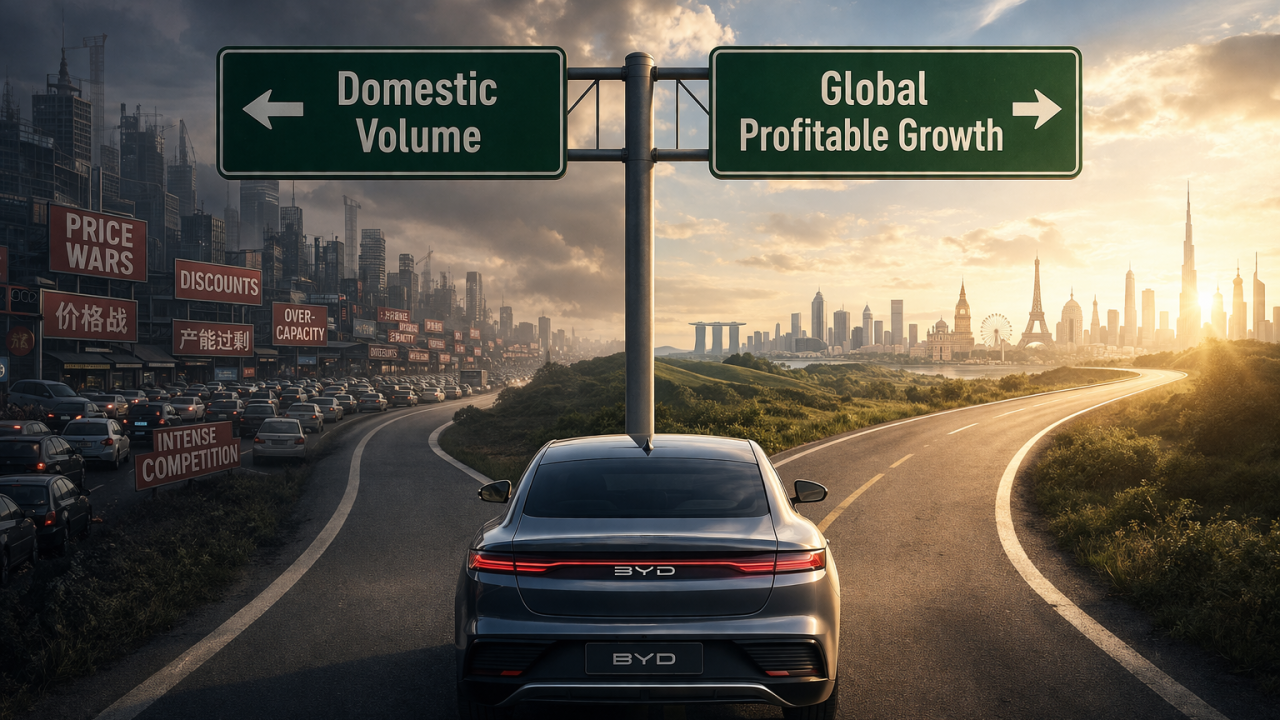
Automobility analysis | BYD at a strategic crossroads, visualized with AI
BYD is slowing down in China. There is no way around that.
Its domestic market share has dropped below 20% in the first two months of the year, a sharp decline from the roughly 35% peak it reached not long ago. At the same time, profit expectations are coming down, and the market is reacting accordingly.
Taken at face value, this looks like a familiar story: rising competition, pricing pressure, and a market leader beginning to lose its edge. But that reading is too narrow, and more importantly, it is anchored in a view of the market that no longer exists.
What is happening with BYD is not simply a loss of momentum. It is a transition—one that reflects a deeper structural shift in China’s automotive market and, increasingly, in the global industry as well.
The real question is not why BYD is losing share in China. The real question is whether holding that share still makes economic sense.
A Market That Has Outgrown Its Old Logic
China’s automotive market has reached a point where scale alone no longer guarantees success.
There is now roughly 45 to 50 million units of production capacity chasing a market of about 25 million units. This is not a temporary imbalance that will correct itself with the next cycle. It is structural overcapacity.
At the same time, new energy vehicle penetration has moved beyond 40%, pushing the market into a more mature phase where growth is no longer the primary driver of competition. Instead, the focus has shifted to pricing, positioning, and differentiation.
The result is a market defined by persistent price pressure. Margins are being compressed not because companies are mismanaging their businesses, but because the underlying economics of the market are changing. For a company like BYD, which built its leadership position on scale and cost advantage, this creates a fundamental tension. Continuing to push volume in such an environment inevitably comes at the expense of profitability.
What we are seeing now is BYD beginning to adjust to that reality.
Competition Has Broadened—and Changed in Character
It is also important to recognize that BYD is no longer competing in the same landscape it dominated even a year ago. At its peak, BYD’s position reflected a market that was still consolidating around a relatively small number of leading players. That phase has passed.
Today, the field is both broader and more complex.
Traditional competitors such as Geely, SAIC, and Changan have accelerated their transition into new energy vehicles and are scaling quickly across multiple segments. At the same time, Huawei-aligned players are reshaping the basis of competition by integrating software, connectivity, and user experience into the core of the product.
And then there is Xiaomi, which may be the most important signal of all.
Xiaomi’s entry is not simply about adding another competitor. It represents the convergence of automotive and consumer electronics—an environment where speed of iteration, ecosystem integration, and brand engagement can matter as much as manufacturing capability.
This is what defines the current phase of the market.
BYD is no longer competing within a traditional automotive framework. It is operating within an ecosystem where the boundaries between industries are dissolving. In that kind of environment, sustained dominance at 30% or higher share is exceptionally difficult to maintain.
What we are seeing in BYD’s share decline is not collapse, but normalization.
The Strategic Pivot: From Domestic Scale to Global Quality
If the changes in China explain the pressure on BYD, they also help explain its response. The most significant shift in BYD’s strategy is happening outside of China.
Exports are moving beyond one million units annually, and in some months have already exceeded 100,000 units. This is not incremental expansion—it is a deliberate reorientation of the business.
The logic is straightforward. Global markets offer structurally better economics. Pricing is stronger, competitive intensity—while increasing—is still less extreme than in China, and margins are more sustainable.
By contrast, large portions of the Chinese market, particularly at lower price points, are becoming increasingly commoditized. In that context, continuing to prioritize domestic volume at all costs would be the wrong strategy.
Instead, BYD is reallocating its focus—from maximizing scale in China to building a more balanced, globally diversified business with higher-quality earnings. This transition is not without cost. It introduces volatility into both market share and profitability, and it challenges investor expectations that were built on a different growth model.
But it is also a necessary adjustment to a changing environment.
The “Leaky Bucket” Reality of China
There is another structural feature of the China market that is often underappreciated: It is exceptionally difficult to hold share over time.
Consumers replace vehicles more frequently than in most other markets. Brand loyalty is relatively weak. Product cycles are fast, and pricing resets are constant. The result is a high degree of churn—what can best be described as a “leaky bucket.”
In such a market, gaining share is only part of the challenge. Holding it requires continuous reinvestment, often at the expense of margins.
For BYD, this raises an important strategic question: is it worth defending every point of market share in a market where the cost of doing so is rising?
The company’s recent actions suggest a clear answer. It is becoming more selective, focusing less on absolute share and more on where it can sustain profitability.

A Misalignment Between Market Expectations and Market Reality
The reaction we are seeing in BYD’s share price reflects a gap between expectations and reality.
The expectation was that BYD’s dominance in China would translate into stable margins and predictable earnings growth.
The reality is more complex.
Domestic growth now comes with margin pressure. Market share is more fluid. And profitability increasingly depends on how effectively companies can expand beyond China and optimize their business mix.
This is not a cyclical adjustment. It is a structural shift. And transitions of this kind are rarely smooth.
What BYD Is Actually Doing
If you step back from the short-term noise, BYD’s strategy becomes clearer.
It is accepting that margin pressure in China is structural, not temporary. It is allowing market share to settle at more sustainable levels rather than defending it at any cost. And it is accelerating its push into global markets where the economic profile of the business is more attractive.
In other words, it is shifting from a model defined by volume leadership to one defined by profit discipline.
That shift is not a sign of weakness. It is an acknowledgment that the rules of the game have changed.
The Bigger Picture
What is happening with BYD is not unique to the company. It reflects a broader transformation in the industry.
The automotive sector is moving away from a model centered on manufacturing scale and toward one defined by ecosystems—where software, connectivity, and user experience play a central role.
China is leading this transition, and BYD, as the market leader, is the first to confront its implications at scale.
The Real Question
BYD’s declining share in China is not the story: it is the visible outcome of a deeper shift.
The real question is whether BYD can successfully execute its transition—building a globally competitive business that delivers sustainable margins in an industry where scale alone is no longer enough.
That is a more difficult challenge than defending domestic share.
But it is also the one that will determine who leads in the next phase of the automotive industry.
About the Author
Bill Russo is the Founder and CEO of Automobility Ltd, and is currently serving as the Chairman of the Automotive Committee at the The American Chamber of Commerce in Shanghai (AmCham Shanghai). His over 40 years of experience includes 15 years as an automotive executive with Chrysler, including 22 years of experience in China and Asia. He has also worked nearly 12 years in the electronics and information technology industries with IBM and Harman. He has worked as an advisor and consultant for numerous multinational and local Chinese firms in the formulation and implementation of their global market and product strategies. Bill is a contributing author to the bookSelling to China: Stories of Success, Failure, and Constant Change (2023), where he describes how China has become the most commercially innovative place to do business in the world’s auto industry – and why those hoping to compete globally must continue to be in the market.
Contact Bill by email at bill.russo@automobility.io
About Automobility
Automobility Limited is global Strategy & Investment Advisory firm based in Shanghai that is focused on helping its clients to Build and Profit from the Future of Mobility. We help our clients address and solve their toughest business and management issues that arise in midst of fast changing, complicated and ambiguous operating environment. We commit to helping our clients to not only “design” the solutions but also raise or deploy capital and assist in implementation, often together with our clients.
Contact us by email at info@automobility.io
Sorry, the comment form is closed at this time.