


17 Jul State of China’s Auto Market – July 2026
Written by Bill Russo, Founder & CEO of Automobility Ltd.

Key Headlines Summary through the 1st Half of 2026
📉 China’s auto market remains under pressure, not in collapse, with total shipments down 4.1% while domestic vehicle sales fell 20.8%.
⚡ Electrification has crossed a structural threshold, with NEVs reaching 49.6% of total shipments, 58.4% in June, and about 63% of passenger vehicle sales.
🌍 Exports are now the industry’s primary volume stabilizer, rising 65.3% to 5.1 million units and reaching nearly 37% of June shipments.
🏭 China is shifting from a domestic growth market to a global production platform, using overseas demand to absorb capacity and sustain scale.
🔀 The market is bifurcating between NEV and ICE ecosystems, with domestic brands controlling NEVs while foreign OEMs remain concentrated in declining ICE segments.
🇨🇳 Chinese brands extended their lead to 72% of passenger vehicle shipments, while German and Japanese brands declined 29.0% and 17.7%.
🧠 Competition is moving from electrification toward intelligence, software, and ecosystem capability, with Leapmotor, HIMA, Xiaomi, and NIO reshaping the rankings.
🚘 China’s automotive future is increasingly defined by exports, NEV scale, software, and global operating capability—not domestic volume growth alone.
China’s Auto Market Contracts, but the Industry’s Structural Transition Accelerates
NEV and Commercial Vehicle Growth Partially Offset Passenger Vehicle Weakness
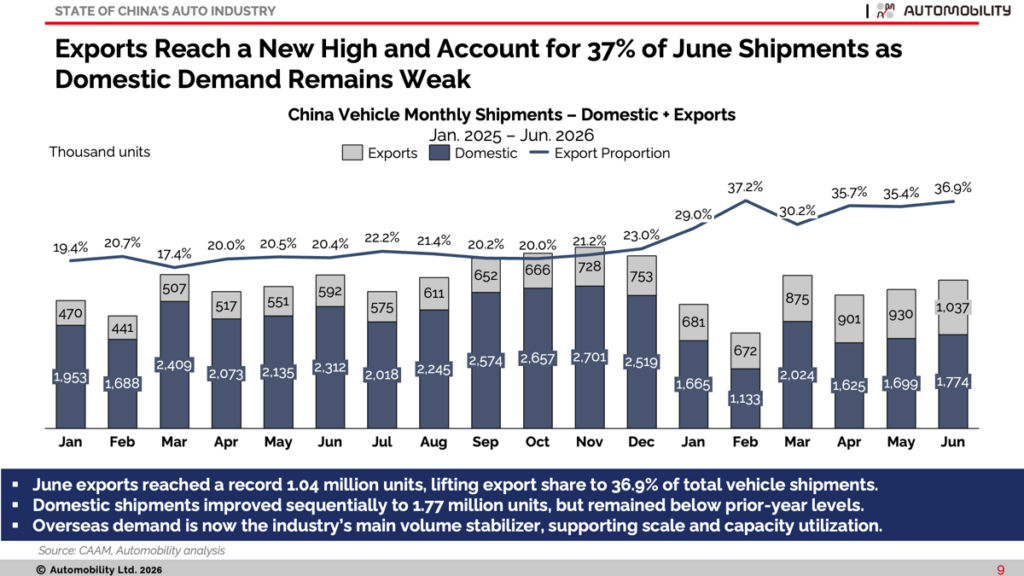
China’s auto industry remained under pressure in the first half of 2026, with total shipments declining 4.1% year over year to 15.0 million units. The slowdown reflects a high 2025 comparison base and continued weakness in passenger vehicles rather than a broad collapse in industry activity. Passenger vehicle shipments fell 6.0% to 12.7 million units, while commercial vehicle shipments increased 8.2% to 2.3 million units, providing a meaningful but insufficient offset.
The market’s underlying performance remains uneven. Commercial vehicles benefited from stronger logistics, infrastructure, and business demand, while passenger vehicles continued to absorb the effects of weaker domestic consumption and the unwind of purchases pulled forward into 2025. Exports also remained an important source of support, accounting for approximately 34% of total first-half shipments and helping manufacturers sustain production scale despite subdued demand at home.
Electrification continued to advance through the downturn. NEV shipments grew 7.3%, adding approximately 500,000 units, while ICE shipments declined 13.1%, a reduction of roughly 1.15 million units. This widening performance gap confirms that the market slowdown is accelerating the structural shift away from combustion vehicles. China’s auto industry is therefore becoming increasingly dependent on NEV growth, commercial vehicles, and exports to offset weakness in the traditional domestic passenger vehicle market.
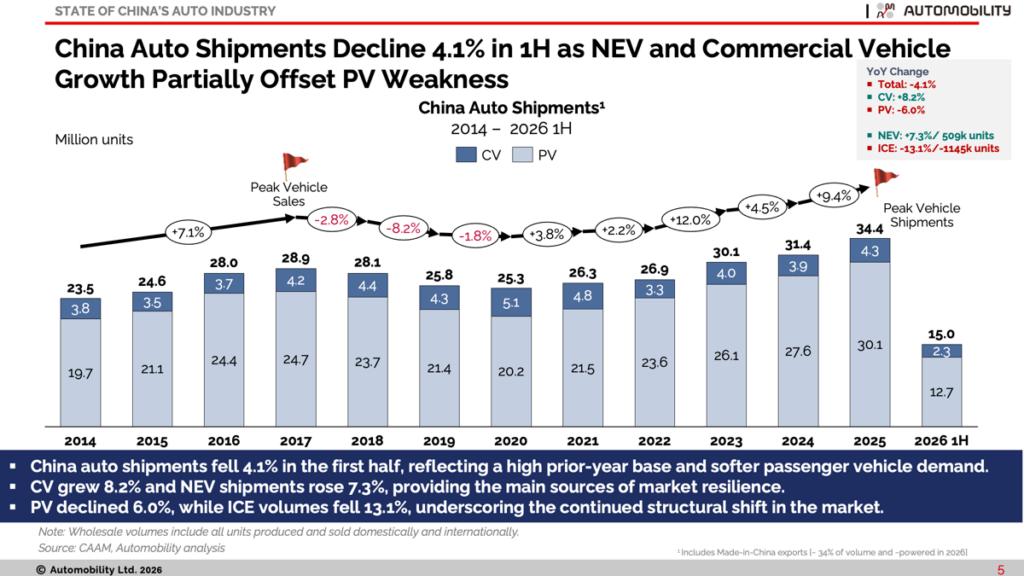
China’s auto market continued to recover sequentially in June 2026, although the year-over-year comparison remained negative. Passenger vehicle shipments increased to 2.40 million units, up from 2.25 million in May, but remained 5.3% below June 2025. Commercial vehicle shipments rose to 409,000 units, an increase of 10.8% year over year. Combined industry shipments reached approximately 2.81 million units, the strongest monthly result of 2026, indicating that the market has moved beyond the February trough even as underlying passenger vehicle demand remains subdued.
The June results reinforce the divergence between passenger and commercial vehicle performance. Passenger vehicle shipments have recovered meaningfully from the early-year low, but the year-over-year decline widened slightly from 4.2% in May to 5.3% in June, suggesting that the improvement remains primarily sequential rather than a broad demand rebound. Commercial vehicles continued to outperform, supported by logistics activity, infrastructure investment, industrial production, and export-related freight demand. CV growth therefore remains an important counterweight to weakness in the much larger passenger vehicle segment.
Exports also continue to play a critical stabilizing role by supporting production volumes and manufacturing utilization despite softer domestic demand. This has created a widening gap between China’s industrial output and the strength of its home market. Manufacturers are increasingly relying on overseas demand and commercial vehicle activity to preserve scale while domestic passenger vehicle sales adjust to the unwind of purchases pulled forward into late 2025.
Overall, the June data points to sequential stabilization rather than a full market recovery. Industry shipments have improved steadily since February, but passenger vehicle volumes remain below prior-year levels and domestic demand is still uneven. China’s auto market is settling into a slower-growth operating environment in which exports and commercial vehicles provide essential support while the passenger vehicle segment undergoes a more prolonged adjustment.
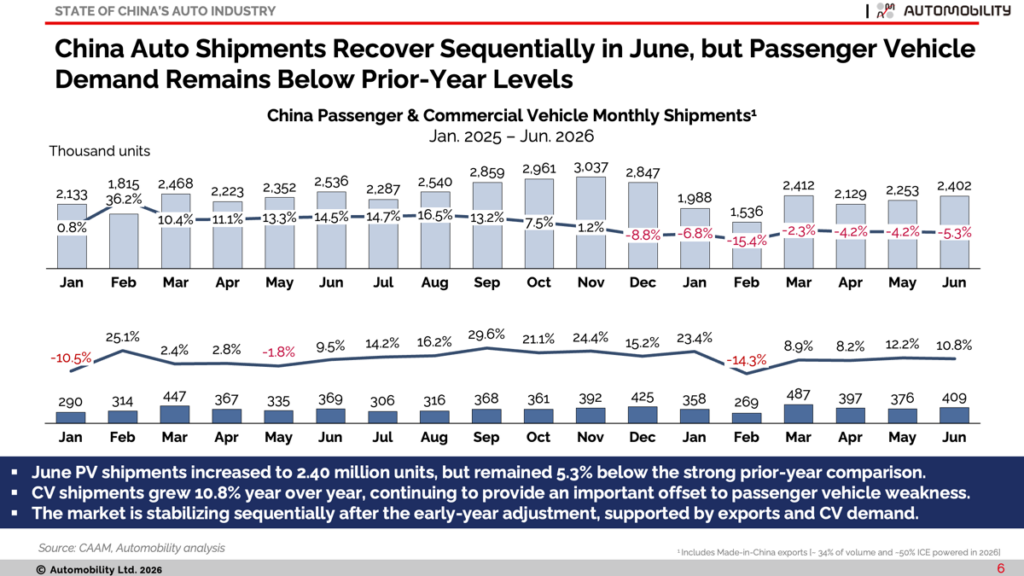
A first-half comparison over the past two years makes the direction of China’s automotive transformation increasingly clear. Total vehicle shipments reached 15.0 million units in 1H 2026, down from 15.7 million a year earlier but still above the 14.0 million recorded in 1H 2024. Passenger vehicle shipments moderated from the 2025 peak to 12.7 million units, while commercial vehicle shipments increased to 2.3 million units, reflecting stronger logistics activity, infrastructure demand, industrial production, and export-related freight movement. The market is therefore operating below last year’s high-water mark, but at a meaningfully different and more export-dependent composition than two years ago.
The most significant shift is occurring beneath the headline volume numbers. ICE domestic sales fell sharply from 6.9 million units in 1H 2024 to 4.8 million in 1H 2026, while NEV domestic sales increased from 4.3 million to 5.1 million units. At the same time, exports have become a much larger pillar of industry scale. ICE exports rose from 2.2 million to 2.7 million units, while NEV exports nearly quadrupled from 605,000 to 2.4 million units. This rebalancing shows that electrification and overseas demand are replacing domestic ICE sales as the industry’s principal sources of structural growth.
The comparison also highlights the growing divergence between production and the home market. Domestic sales weakened materially, but total shipments remained comparatively resilient because exports absorbed more of China’s output. Overseas demand now supports manufacturing utilization, scale, and supplier economics in a way that was far less important just two years ago. This makes China’s auto industry increasingly exposed to global demand conditions, trade policy, localization requirements, and the ability of its leading OEMs to build durable operations outside China.
China’s auto industry is no longer being driven primarily by domestic volume expansion. Growth is increasingly supported by the combined forces of electrification, export expansion, and global market integration. As the home market matures, NEVs and overseas markets are becoming the main engines of incremental scale, reinforcing China’s evolution from a domestic auto market into a globally connected automotive production and technology ecosystem.
Exports Become China’s Auto Industry Volume Stabilizer
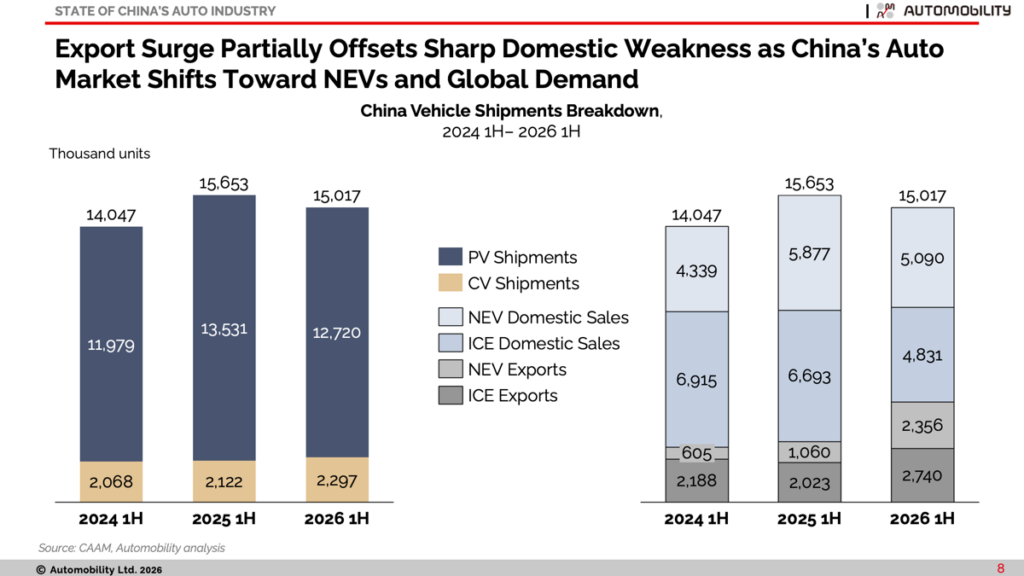
China’s automotive industry moved further toward an export-supported operating model in June 2026, with overseas shipments reaching a record 1.04 million units and accounting for 36.9% of total vehicle shipments. Domestic shipments also improved sequentially to 1.77 million units, but remained below prior-year levels. The widening gap between domestic and export performance confirms that overseas demand is no longer simply absorbing temporary excess capacity; it has become a core pillar supporting industry scale and factory utilization.
This shift is increasingly structural. Export share has remained above 35% for three consecutive months and is nearly double the levels seen at the start of 2025. Manufacturers are therefore relying more heavily on global markets to offset slower growth at home, stabilize production, and preserve supplier and manufacturing economics. What began as a response to overcapacity is evolving into a broader internationalization strategy, with exports now shaping product planning, capacity allocation, and investment decisions.
The importance of exports extends beyond volume support. Overseas markets can offer stronger pricing, less severe discounting, and better margin opportunities than China’s hypercompetitive domestic market, although trade barriers, localization requirements, and distribution costs are also rising. Growth across both ICE and NEV exports demonstrates widening global acceptance of Chinese vehicles, but it also increases exposure to foreign regulation and geopolitical risk.
China’s auto industry is consequently becoming a more globally integrated production system. Exports now serve a dual role: stabilizing near-term industry volume and utilization while accelerating the long-term globalization of Chinese OEMs and supply chains.
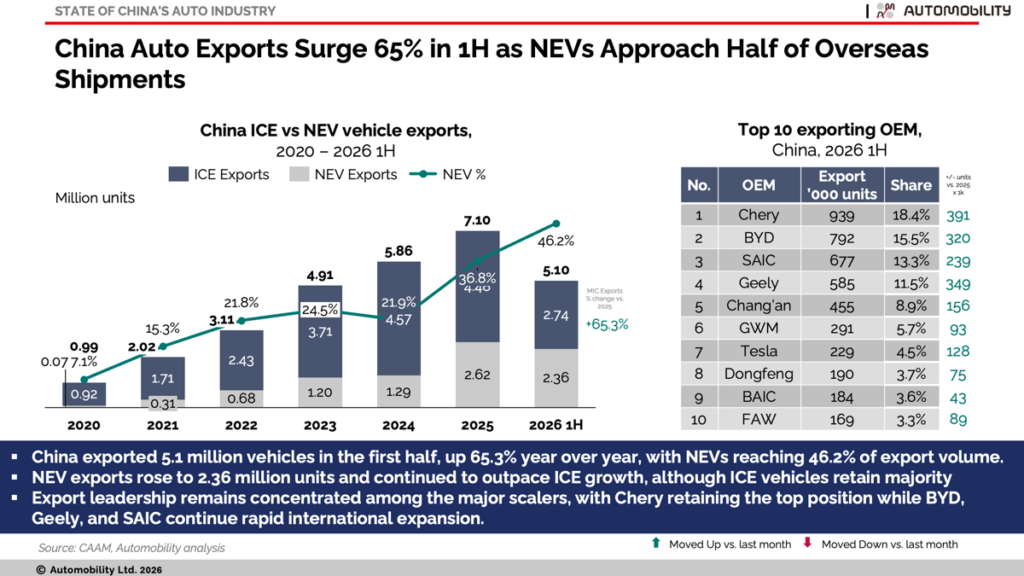
China’s auto exports accelerated sharply in the first half of 2026, reaching 5.1 million units, up 65.3% year over year. At the same time, the export mix continued shifting toward electrification, with NEVs accounting for 46.2% of total overseas shipments, up from just 15.3% in 2021. The data shows that China’s export competitiveness is moving beyond manufacturing scale and cost advantage toward a broader combination of electrified products, intelligent vehicle capability, and global market reach.
ICE vehicles still represented a narrow majority of exports at 2.74 million units, but NEV exports rose to 2.36 million units and continued to grow faster. This reflects a broader transition from exports as a utilization strategy toward a model centered on global market-share expansion, higher-value product mix, and long-term ecosystem positioning. Chinese OEMs are increasingly using overseas markets not only to sustain scale, but also to access regions with stronger pricing and less intense competitive pressure than China’s domestic market.
Export leadership remains concentrated among the major scalers. Chery retained the top position with 939,000 units, followed by BYD at 792,000, SAIC at 677,000, and Geely at 585,000. Chang’an, GWM, and Tesla also remained significant exporters. The breadth of this group demonstrates that global capability is becoming a core strategic requirement across China’s leading OEMs rather than a niche advantage held by only one or two companies.
Viewed structurally, China’s export story is no longer simply about absorbing excess capacity. The industry is integrating itself more deeply into the global automotive value chain as a major supplier of both ICE and NEV products. As NEVs approach half of overseas shipments, China’s long-term export competitiveness is increasingly defined by technology leadership, ecosystem capability, scale, and the ability to build durable operating models in international markets.
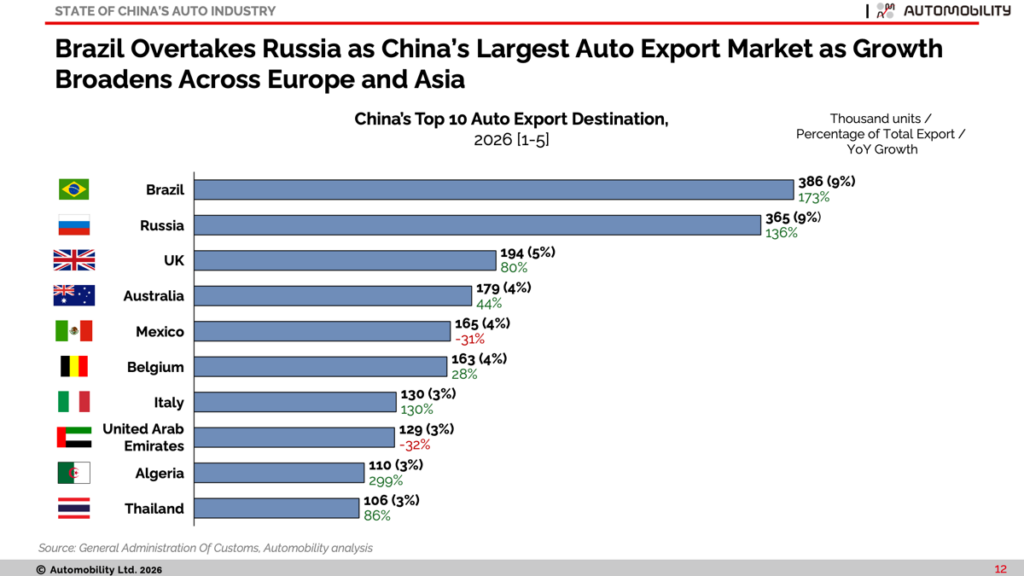
China’s automotive export expansion is becoming more geographically diversified, although it remains concentrated in a relatively small group of major markets. Through the first five months of 2026, Brazil overtook Russia as China’s largest auto export destination, reaching 386,000 units, up 173% year over year, compared with Russia’s 365,000 units, up 136%. The shift shows that China’s export momentum is increasingly supported by a broader mix of Latin American, European, Asian, and emerging-market destinations rather than any single market.
The composition of growth is also changing. The UK reached 194,000 units, up 80%, while Australia grew 44% to 179,000 units. In Europe, Belgium increased 28% and Italy rose 130%, confirming the region’s strategic importance despite tariffs and regulatory pressure. Europe matters not only for volume, but also for average selling price and product mix, as Chinese OEMs can place a higher proportion of premium EVs, intelligent vehicles, and better-equipped models there. Even after logistics, homologation, channel costs, and tariffs, Europe can deliver stronger revenue per vehicle while supporting brand positioning and technology validation.
Growth across Thailand, up 86%, and Algeria, up 299%, highlights the expanding role of Southeast Asia and Africa, but these markets generally offer a more affordability-driven mix than Europe. Performance also remains uneven: Mexico declined 31% amid trade and industrial-policy uncertainty, while the UAE fell 32%. Export outcomes are therefore being shaped not only by product competitiveness, but also by market access, trade policy, regional demand, and geopolitical risk.
Viewed structurally, China’s export model is evolving from an overflow channel into a broader global operating system. The rise of Brazil, continued growth in Europe, and expansion across Asia and Africa are reducing dependence on any single destination. At the same time, Europe is playing an outsized role in ASP uplift, premium mix, technology credibility, and long-term brand development, while emerging markets provide scale and diversification. The next phase will depend increasingly on localization, distribution, and durable international operating capability rather than shipment growth alone.
NEVs Become the Majority of China’s Domestic Vehicle Sales
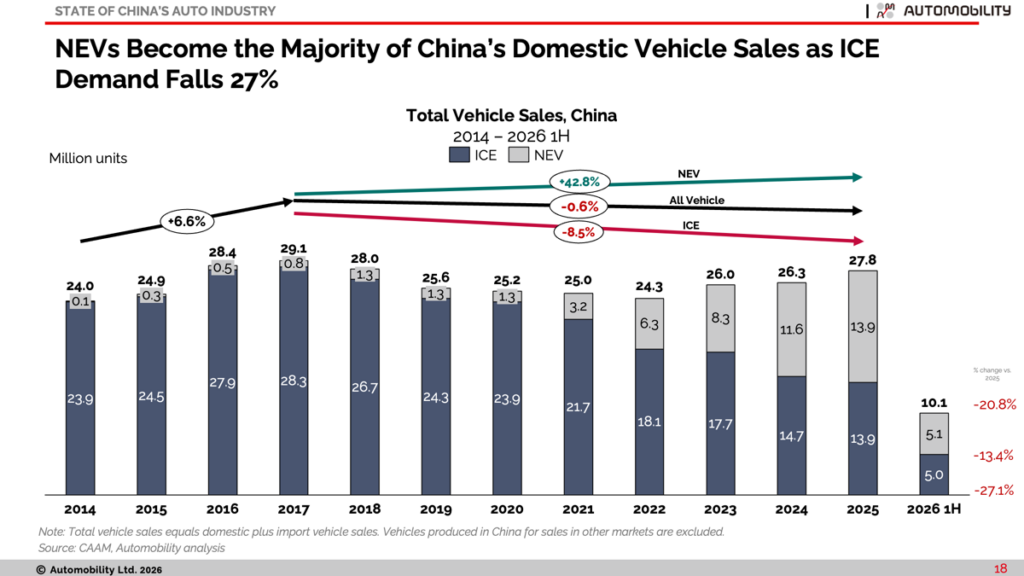
China’s domestic auto market remained under significant pressure in the first half of 2026, with total vehicle sales falling 20.8% year over year to 10.1 million units. The decline reflects the partial unwind of the exceptionally strong, subsidy-supported demand environment of late 2025, along with cautious consumer sentiment and heightened price sensitivity. The market is settling into a more mature, demand-constrained phase in which replacement purchases, product mix, and affordability matter more than broad volume expansion.
The downturn remains highly uneven across powertrains. ICE sales fell 27.1% to 5.0 million units, while NEV sales declined a more moderate 13.4% to 5.1 million units. That relative outperformance pushed NEVs slightly above ICE vehicles for the first time on a first-half domestic sales basis. Electrification is therefore continuing to gain share even without absolute market growth, showing that consumers are still reallocating demand away from combustion vehicles despite weaker overall conditions.
The long-term structural trajectory remains intact. China’s NEV market has expanded from a marginal position a decade ago to a majority of domestic vehicle sales, while ICE demand has steadily eroded. The current slowdown does not reverse that transition; it accelerates the redistribution of share toward electrified products and exposes the vulnerability of OEMs whose portfolios remain heavily dependent on ICE vehicles.
The industry’s operating model is consequently changing. With domestic demand stabilizing at a lower baseline, growth and profitability will depend increasingly on mix improvement, software and feature monetization, exports, manufacturing discipline, and brand strength rather than pure volume expansion. China’s auto market is no longer primarily a story of demand growth. It is becoming a story of structural replacement, electrification-led share gains, and competition for value within a mature market.
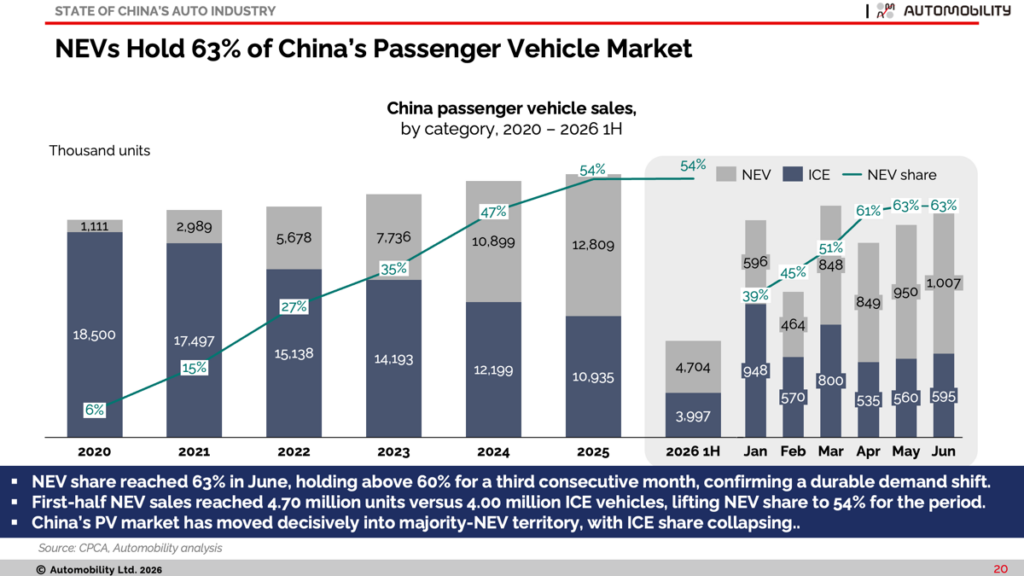
China’s passenger vehicle market remained soft in absolute terms through the first half of 2026, but the transition toward electrification became more firmly established. NEV share rose from 39% in January to 63% in June, remaining above 60% for a third consecutive month. First-half NEV sales reached 4.70 million units, compared with 4.00 million ICE vehicles, giving NEVs a 54% share for the period. The market has therefore moved decisively into majority-NEV territory even as overall consumer demand remains below the elevated levels of 2025.
The key story is not a broad rebound in volume, but a continued reallocation away from ICE vehicles. Electrified products are gaining share through stronger affordability, product competitiveness, and consumer preference, while ICE vehicles compete for a shrinking portion of demand. As a result, competition is shifting from EV adoption itself toward software, intelligent driving, user experience, ecosystem integration, and cost control within an increasingly mature NEV-led market.
BYD Retains Lead as China’s EV Market Fragments Around Tech-Led Challengers
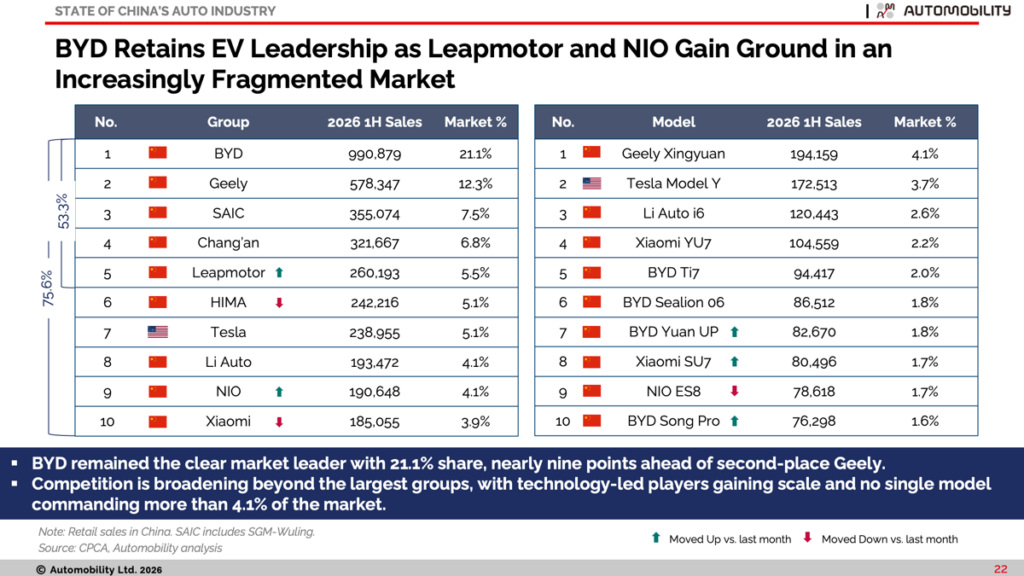
China’s EV market is becoming more competitive as growth shifts from electrification itself to competition within a majority-NEV market. BYD remained the clear leader in the first half with 21.1% share, nearly nine points ahead of Geely, while SAIC and Chang’an retained scale positions. Beneath the leaders, however, the market is increasingly fluid: Leapmotor moved into fifth place and NIO climbed to ninth, while HIMA and Xiaomi slipped in the rankings. No single model held more than 4.1% share, underscoring how fragmented and fast-moving the competitive landscape has become.
Technology-led challengers are gaining relevance through faster product cycles, software capability, intelligent features, and ecosystem integration rather than manufacturing scale alone. Geely Xingyuan led the model ranking, followed by Tesla Model Y, while Li Auto, Xiaomi, NIO, and several BYD models remained prominent. The result is a multi-polar market in which BYD retains structural leadership, but competitive advantage below the top tier is increasingly determined by execution speed, differentiated user experience, and the ability to scale intelligent EV platforms quickly.
China’s passenger vehicle market is separating into two increasingly distinct competitive ecosystems: a shrinking ICE segment still led by foreign OEMs and a larger NEV segment dominated by Chinese brands. In the first half of 2026, NEV passenger vehicle sales reached 4.70 million units, exceeding ICE sales by roughly 700,000 units. Volkswagen and Toyota remain the largest ICE players, while BYD, Geely, SAIC, Chang’an, and Leapmotor lead the NEV market. The limited overlap between the two leaderboards shows that China has moved beyond a simple powertrain transition and into a new phase in which competitive relevance is increasingly determined by strength in the NEV ecosystem.
Only Geely and Chang’an rank among the top ten in both ICE and NEV, underscoring the strategic value—and difficulty—of maintaining competitive portfolios across both markets. Most foreign OEMs remain concentrated in the structurally declining ICE segment, while domestic players control the larger and faster-moving arena of intelligent electric vehicles. As NEVs continue to widen their lead, legacy ICE scale will provide diminishing protection; advantage will accrue to companies that can manage the transition while building competitive software, technology, product, and ecosystem capabilities for an NEV-led market.
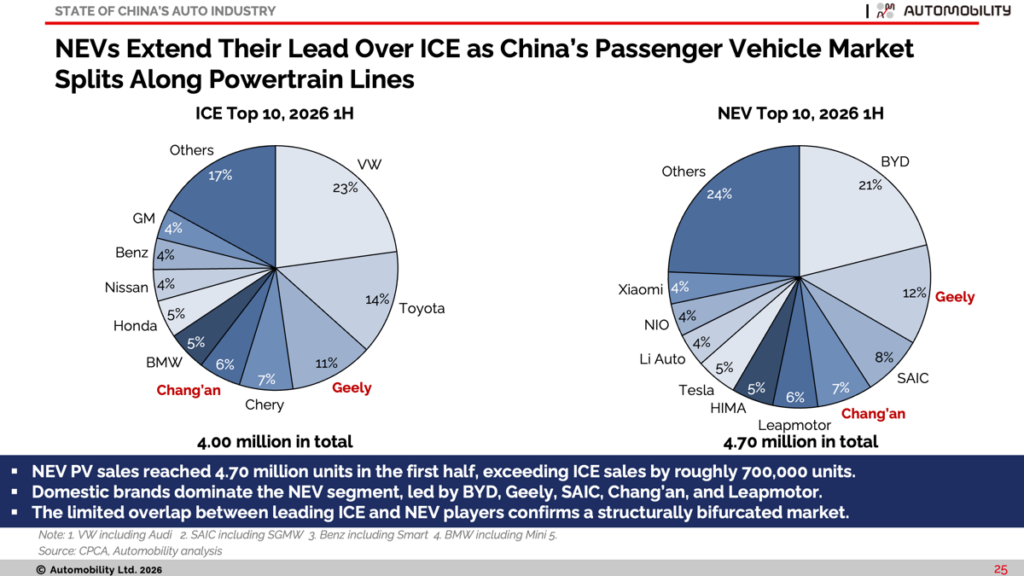
The market’s decisive divide is no longer simply ICE versus NEV, but relevance versus decline. NEVs now lead China’s passenger vehicle market, while foreign OEMs remain concentrated in a shrinking ICE profit pool. Geely and Chang’an stand out as rare players with meaningful positions in both segments, demonstrating the value of portfolio breadth—but only when backed by active capital reallocation toward NEVs.
Within NEVs, scale alone is no longer enough. BYD leads, but competition is fragmenting across Geely, Leapmotor, HIMA, Xiaomi, Li Auto, NIO, and Tesla. Advantage is shifting to companies that can combine software, intelligent features, cost control, ecosystem strength, and rapid product execution. The winners will be those able to remain relevant across technologies, customer segments, and global markets; the losers will be those trapped in a single declining position.
Chinese OEMs Consolidate Market Leadership as Geely and BYD Pull Ahead of VW
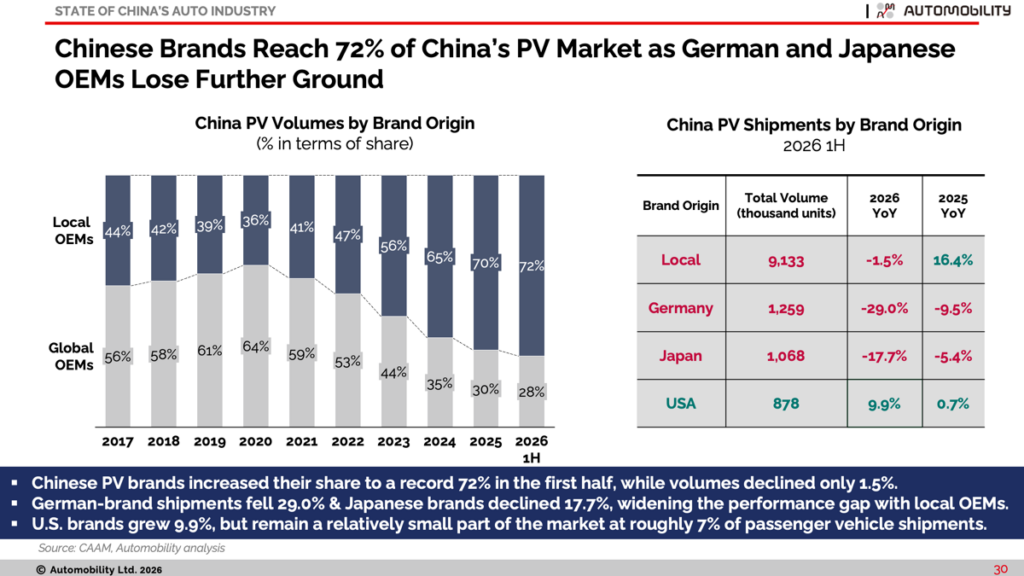
Chinese brands have strengthened their position further, increasing passenger vehicle share to 72% in the first half. More importantly, local-brand volumes improved on a relative basis: the year-over-year decline narrowed to 1.5%, indicating that Chinese OEMs are now close to holding volume despite the broader market contraction.
Foreign-brand pressure intensified. German-brand shipments deteriorated by -29.0%, while Japanese brands weakened by -17.7%. The widening gap confirms that the market downturn is accelerating share transfer toward local OEMs rather than affecting all brands evenly.
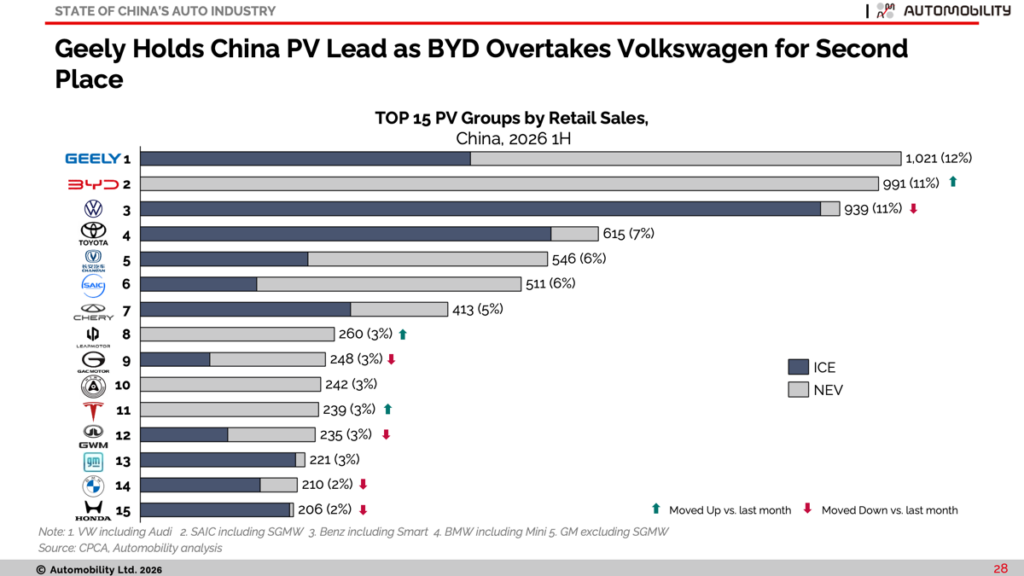
The first-half rankings mark another symbolic shift in China’s passenger vehicle market. Geely remained the largest group with 1.02 million retail sales, while BYD overtook Volkswagen for second place with 991,000 units. The gap among the top three is now narrow, but their portfolio structures are very different: Geely combines meaningful ICE scale with a growing NEV business, BYD is almost entirely electrified, and Volkswagen remains overwhelmingly dependent on ICE demand.
The broader ranking reinforces the transfer of market leadership toward Chinese OEMs. Geely, BYD, Chang’an, SAIC, Chery, Leapmotor, GAC, and GWM occupy most of the leading positions, supported by faster product cycles and stronger participation in NEVs. Leapmotor’s rise to eighth and Tesla’s move to eleventh also show that technology-led players can gain rapidly, while traditional foreign brands remain concentrated in slower-growing or contracting segments.
The competitive lesson is increasingly clear: scale must be aligned with the market’s changing mix. Geely’s balanced portfolio provides near-term resilience, while BYD’s NEV scale gives it stronger exposure to the market’s structural direction. Foreign OEMs such as Volkswagen and Toyota retain significant volume, but their leadership is becoming less defensible unless they can translate legacy scale into competitive intelligent and electrified products.
Conclusion: The Battle Has Shifted from Electrification to Competitive Relevance
China’s auto industry has moved beyond the question of whether electrification will prevail. The market is now defined by a harder test: which companies can remain relevant as growth slows, product cycles compress, and competition shifts toward software, intelligent features, ecosystem strength, cost control, and execution speed.
Exports have become essential to sustaining scale, but international expansion alone will not guarantee success. The next phase will reward companies that can convert domestic scale into durable global operating models, stronger brands, and competitive economics across multiple markets.
The competitive structure is also becoming more polarized. Chinese OEMs dominate the NEV ecosystem, while many foreign brands remain concentrated in a shrinking ICE market. A small group of companies can still compete across both, but portfolio breadth only matters when backed by credible technology, rapid capital reallocation, and disciplined execution.
China’s auto industry is entering a more mature and unforgiving phase. The winners will not simply be the largest manufacturers or fastest-growing EV brands, but the companies best able to sustain profitability, technological relevance, and global scale as the basis of competition continues to evolve.
AmCham Shanghai State of China Auto Market Monthly Webinar [July 23]
The American Chamber of Commerce in Shanghai ‘s Automotive Committee invites you to our Monthly State of China’s Automotive Industry webinar on Thursday, July 23, from 9:00 am – 10:15 am, to be held via Zoom Meeting.
We will provide updated information on sales results through June. We will also share our observations of other major trends in the auto industry.
This event is held virtually. A Zoom link will be provided via email once registration is completed.
Webinar | State of China Auto Market Monthly Briefing (July) | AmCham Shanghai
JUNE EVENTS HIGHLIGHTS
June was an active month in Europe, with speaking engagements in Italy, Vatican City and Portugal focused on AI and how China is the accelerating transformation of the global automotive industry.
Business Ethics Summit – Vatican City
On June 16, I had the privilege of participating in the Business Ethics Summit at the Vatican, where global leaders gathered to examine the implications of artificial intelligence on business and society. The setting was symbolic: at a moment when technology is accelerating faster than governance frameworks can adapt, the discussion focused on a fundamental question—how to ensure that human agency remains at the center of decision-making. My contribution emphasized that while AI can enhance speed, scale, and insight, it cannot replace accountability. In sectors like mobility, where systems are becoming increasingly autonomous and software-defined, the risk is not technological failure, but the erosion of responsibility if humans step too far out of the loop.

The takeaway is straightforward: leadership—not technology—will determine outcomes. AI must be deployed as an instrument of human intent, guided by clear ethical frameworks and active oversight. This perspective is explored further in my article, Business Ethics in the Age of AI: Why Human Agency Matters More Than Ever, which reflects on the discussions at the summit and their implications for industry transformation. You can read the full piece here:
Business Ethics in the Age of AI: Why Human Agency Matters More Than Ever
Best of Belron 2026 – Lisbon, Portugal
On June 24, I had the opportunity to deliver a keynote address at Best of Belron® 2026 in Lisbon, one of the world’s premier gatherings of automotive service professionals, technology partners, and industry leaders. The conference brought together more than 1,600 participants to explore the forces reshaping mobility, from AI and software-defined vehicles to changing customer expectations and the future of automotive services. My presentation, “The Big Influences: When Cars Become Smart Devices – Lessons from China’s Mobility Revolution and the Implications for the Automotive Aftermarket,” argued that the automobile is evolving from a mechanical product into a connected, intelligent platform. As software, AI, and data become defining sources of value, the aftermarket must evolve from repairing hardware to maintaining the performance, trust, and continuous improvement of intelligent mobility systems.
The central message was that China’s mobility ecosystem offers an early view of where the global industry is headed. The companies that thrive will be those that recognize vehicles as continuously evolving digital products rather than static manufactured goods. This transformation demands new capabilities in software, diagnostics, customer experience, and ecosystem partnerships—creating significant opportunities for organizations prepared to embrace change. I explore these themes in greater detail in my accompanying article, “The Big Influences: When Cars Become Smart Devices,” which can be read here:
The Big Influences: When Cars Become Smart Devices
Beyond the public conferences, I spent a full day at the headquarters of a leading European Tier 2 automotive supplier near Turin, exchanging perspectives on how software, AI, and China’s mobility revolution are reshaping the industry’s competitive landscape.
I also met with John Rossant, Founder and CEO of CoMotion, to discuss expanding the collaboration between our organizations. Together, these engagements reinforced a central theme that emerged throughout the month: the future of mobility will be shaped not only by technological innovation, but by stronger partnerships, shared learning, and a willingness to collaborate across industries and geographies.
🎙️ Catch up on the latest episodes of the Auto Insider Podcast hosted by Bill Russo, featuring insights from the front lines of China’s mobility transformation — where speed, scale, and strategy are redefining global competition.
🌏 Episode #6: From Tier-1 to System Architect: Aptiv at China Speed, Global Scale with Simon Yang,President, China & Asia Pacific, Aptiv
🌏 Episode #5: Safety Without Borders: How Autoliv Drives Scaled Collaboration in the Smart Mobility Era with Sng Yih, President, Autoliv China
🌏 Episode #4: Leapmotor’s Global Leap — A New Paradigm for Global EV Collaboration with Michael Wu, Co-President, Leapmotor
🚗 Episode #3: Competing at China Speed: A Tier-1 Perspective from Magna with Zhen Wu, President of Magna China
🦋 Episode #2: The Butterfly Effect—How China’s Auto Shift is Reshaping the World with Dr. Xiaozhi Liu, Founder and CEO of ASL Automotive, Former CEO of Fuyao Glass
🔧 Episode #1: Smart EVs and the Smart Tier 0.5 Supply Chain with Jack Cheng , Co-Founder of NIO and CEO of M-Mobility
We’re just getting started — more conversations coming soon with the visionaries shaping the future of mobility.
You can follow us for regular updates on these online channels by scanning the QR codes:

If your organization would like a custom briefing on the State of China’s Auto Market, please reach out to us at info@automobility.io
About Bill Russo
Bill is a contributing author to the book Selling to China: Stories of Success, Failure, and Constant Change (2023), where he describes how China has become the most commercially innovative place to do business in the world’s auto industry – and why those hoping to compete globally must continue to be in the market.
About Automobility
Contact us by email at info@automobility.io
PLEASE NOTE: The information and analysis shared in this newsletter, including the charts and style of materials presented, is the intellectual property of Automobility Ltd. While we share it as a way to serve our existing and new clients, it is not to be used without our express consent and then only with attribution. Any publication, reproduction or other use of this material without the express written consent of Automobility Ltd is prohibited.
No Comments