


13 Jul The Big Influences: When Cars Become Smart Devices
Lessons from China’s Mobility Revolution and the Implications for the Automotive Aftermarket
by Bill Russo
Lisbon, Portugal
June 24-25, 2026
I recently had the privilege of delivering the keynote presentation “The Big Influences: When Cars Become Smart Devices – Lessons from China’s Mobility Revolution and the Implications for the Automotive Aftermarket” at Best of Belron 2026 in Lisbon, Portugal.

Best of Belron is one of the automotive aftermarket’s premier global events. Every two years, Belron brings together thousands of colleagues, franchise partners, suppliers and customers from around the world to celebrate technical excellence, recognize the world’s best vehicle glass technicians and share perspectives on the future of the industry. Throughout the week, keynote speakers explored themes ranging from leadership and high performance to innovation, customer experience and the importance of embracing change.
My role was to examine one of the most significant external forces that will shape the future of every company operating in the automotive ecosystem: the transformation of the automobile itself.
For most of the past century, the automotive industry has been defined by advances in mechanical engineering. Today, however, we are witnessing something fundamentally different. The car is evolving from a machine into a connected, software-defined smart device. Electrification is an important milestone in that journey, but it is not the destination. Software, artificial intelligence, sensors, connectivity and data are rapidly becoming the primary sources of competitive advantage and customer value.
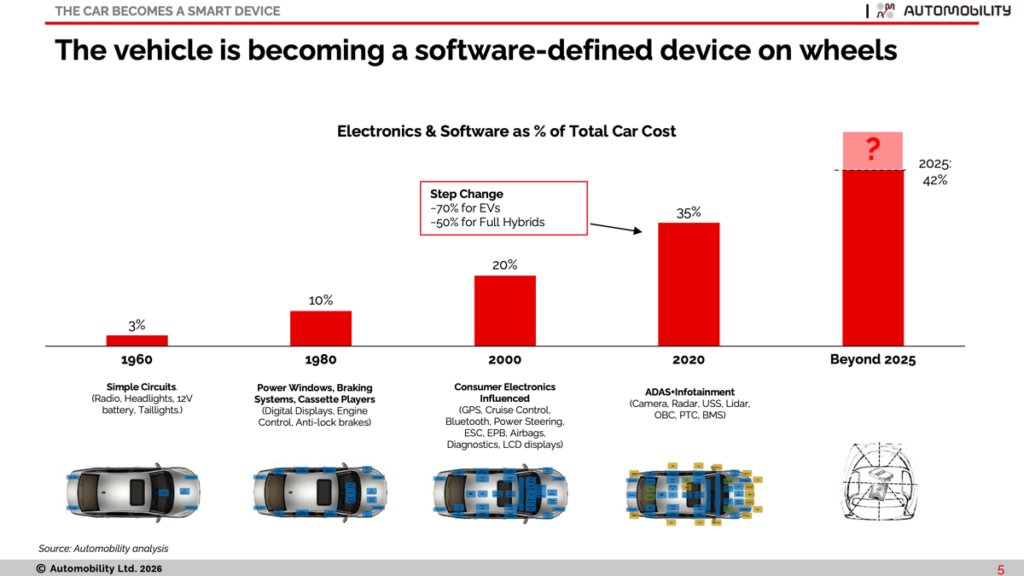
The evolution of the automobile: from mechanical machine to connected smart device
This transformation mirrors what happened previously in the computing and consumer electronics industries. Computers became connected platforms. Mobile phones became smartphones. Today, the automobile is following the same trajectory. As electronics and software account for an ever-larger share of vehicle value, intelligence increasingly defines the product. The industry is shifting from horsepower to compute power, from mechanical differentiation to digital capability, and from product engineering to ecosystem design.
China provides perhaps the clearest view of where this transformation is heading.
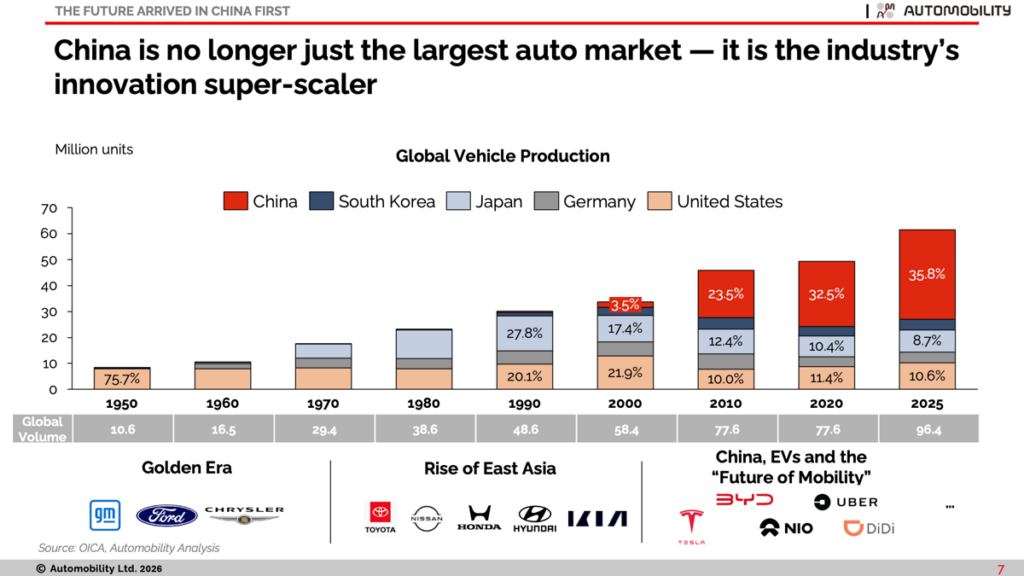
China as the world’s largest automotive market and proving ground for mobility technologies
Having become the world’s largest automotive market, China has also become the industry’s largest proving ground for commercializing new mobility technologies. Scale, competition and an increasingly digital consumer have accelerated innovation to a pace unmatched elsewhere.
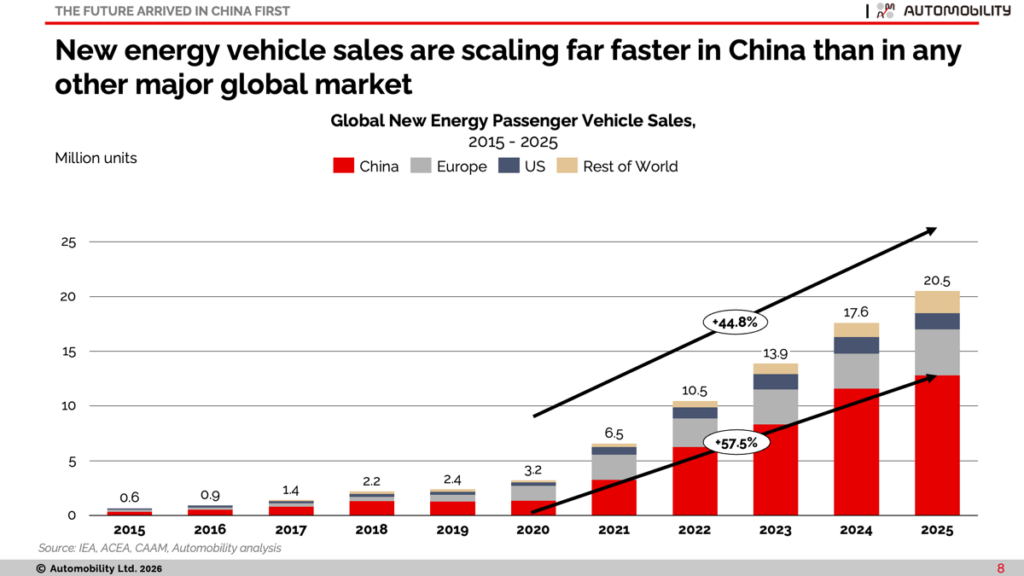
China is setting the path to commercialization of new technologies at scale
During my presentation, I argued that China’s importance extends well beyond electric vehicles. The country is demonstrating a fundamentally different operating model for the automotive industry-one that integrates software development, manufacturing, artificial intelligence and digital services into a single ecosystem.
To illustrate this evolution, I introduced what I describe as the Three Waves of Automotive Disruption.
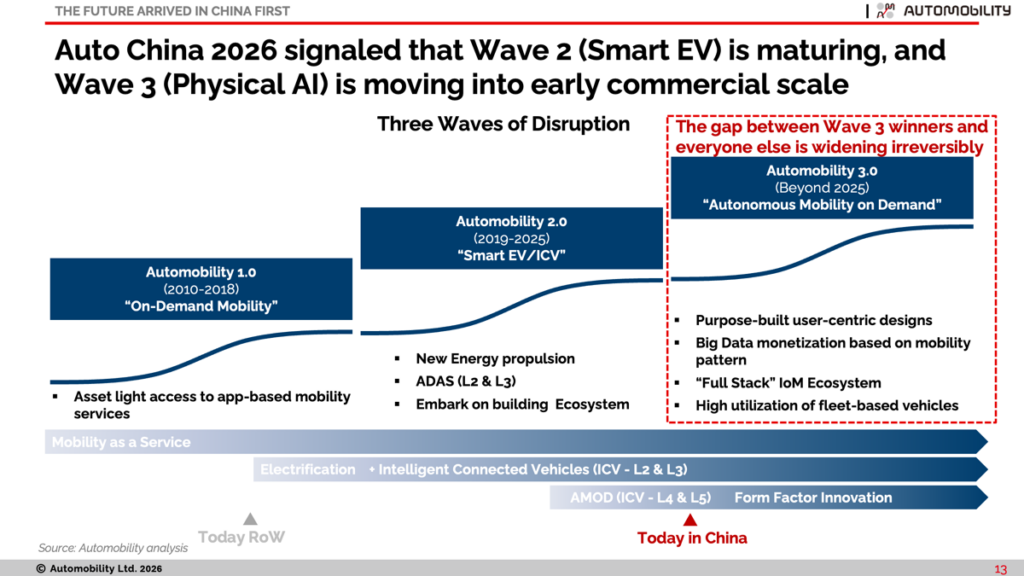
Three Waves of Automotive Disruption: digital platforms, intelligent connected vehicles, and autonomous systems
The first wave transformed mobility through digital platforms that shifted value from vehicle ownership toward mobility services. Companies such as Uber and Didi demonstrated that mobility itself could become an on-demand digital service.
The second wave combined electrification with intelligent connected vehicles. This is the phase now unfolding globally. Electric propulsion provides the platform, while advanced driver assistance systems, cloud connectivity, over-the-air software updates and increasingly sophisticated digital experiences redefine both the vehicle and the customer relationship.
China is already moving into the third wave. Autonomous driving, Physical AI, robotics and new mobility business models are beginning to move from demonstration to commercialization. The important point is not simply that these technologies exist. Rather, China is compressing the timeline required to scale them, creating an increasingly significant competitive advantage.
This evolution is changing the rules of competition.
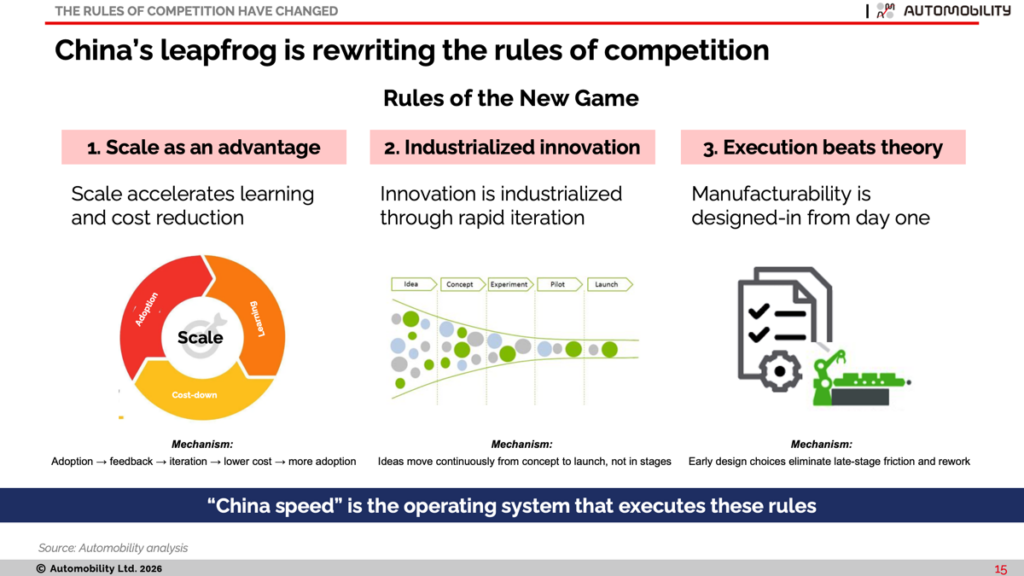
Changing rules of competition: from manufacturing excellence to software iteration and data leverage
For decades, automotive leadership depended upon manufacturing excellence, engineering refinement and product quality. Those capabilities remain important, but they are no longer sufficient. Competitive advantage increasingly depends upon the ability to iterate software rapidly, leverage data continuously, integrate across ecosystems and execute at extraordinary speed. Scale accelerates learning. Learning reduces cost. Faster iteration creates better products. These reinforcing cycles explain much of China’s competitive momentum today.
Perhaps the most significant implication of this transformation is that value is migrating beyond the vehicle itself.
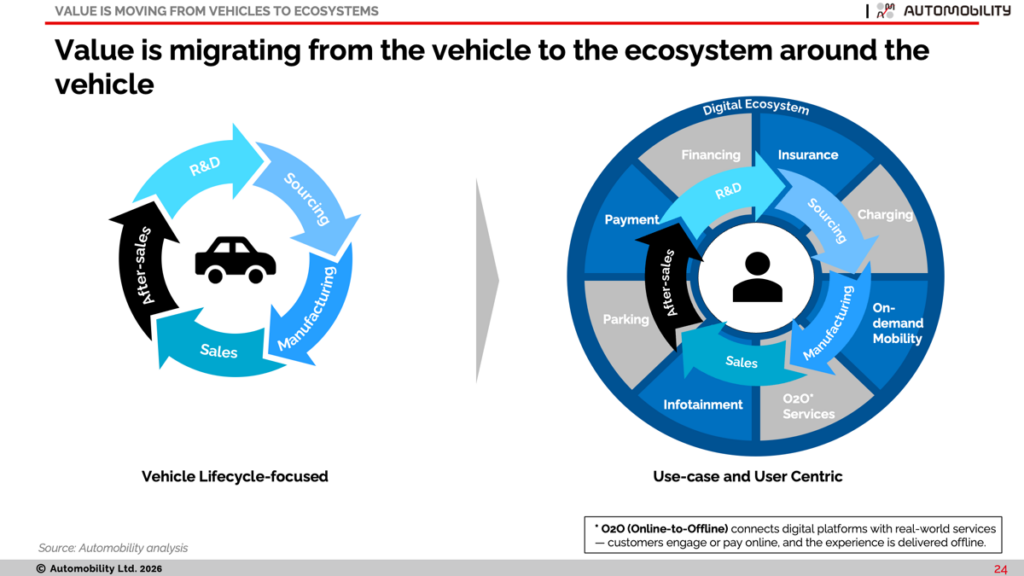
Value migrating beyond the vehicle: ecosystem services and digital experiences
Historically, value creation focused primarily on designing, manufacturing and selling automobiles. Increasingly, however, value resides in the ecosystem surrounding the vehicle. Software platforms, cloud services, insurance, financing, charging, entertainment, navigation, predictive maintenance and artificial intelligence are becoming integral parts of the ownership experience. Companies such as Xiaomi and Huawei illustrate this shift particularly well. They approach the automobile not simply as transportation, but as another connected device within a much broader digital ecosystem.
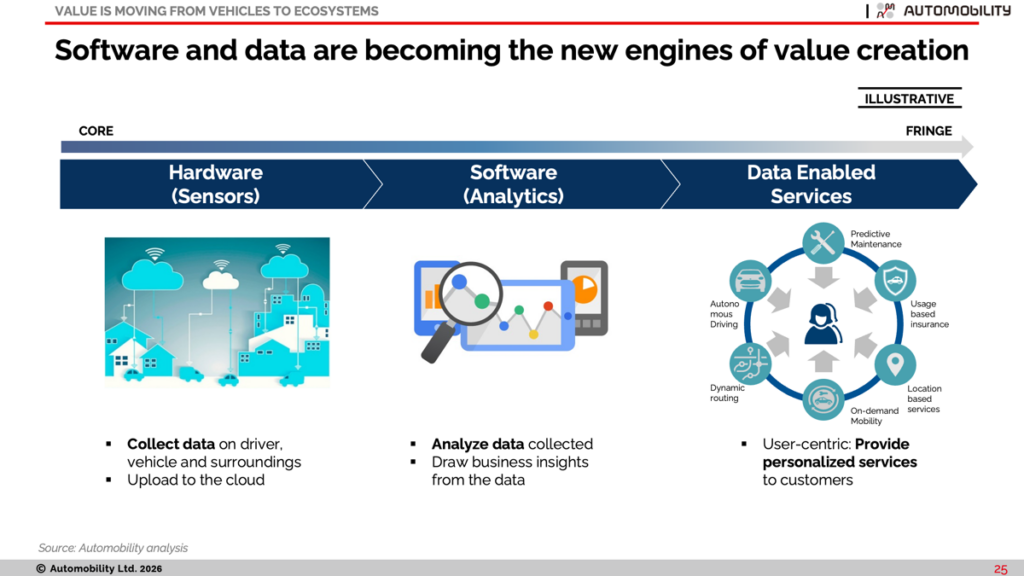
Companies like Xiaomi and Huawei approach the automobile as a connected device within a broader ecosystem
This shift has profound implications for the automotive aftermarket.
As vehicles become increasingly intelligent, repair becomes increasingly digital. A windshield replacement may involve recalibrating cameras, validating sensors, updating software and ensuring that advanced driver assistance systems continue to operate exactly as designed. Repair is no longer limited to restoring damaged components. It increasingly requires restoring the performance of an integrated intelligent system.
This is why I believe the role of the aftermarket is evolving from repair execution to trust restoration.
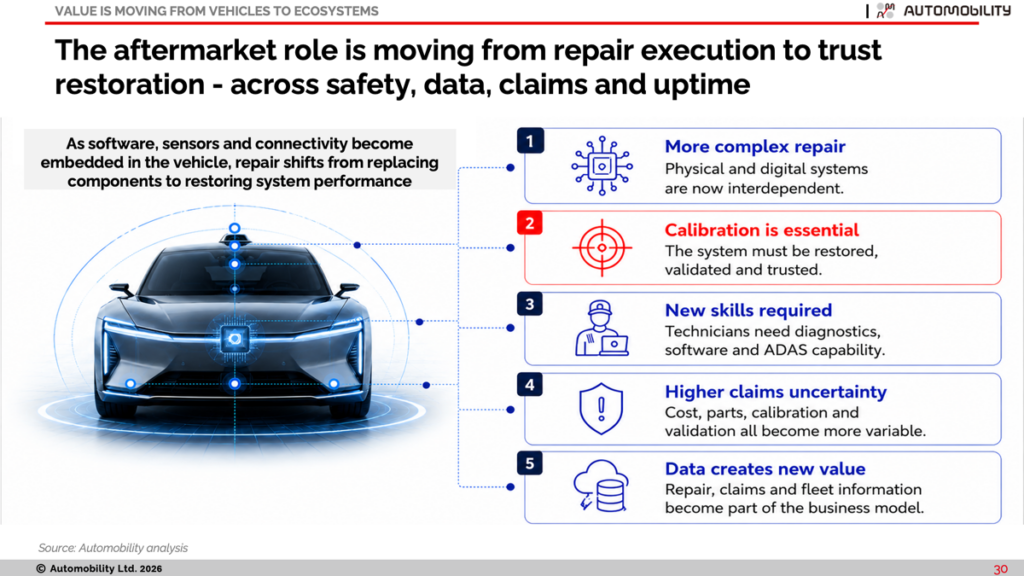
The aftermarket’s role evolving from repair execution to trust restoration for intelligent vehicle systems
Customers, insurers and fleet operators are placing greater value on certainty. They need confidence that every safety system, every sensor and every software-enabled function performs exactly as intended after repair. Trust therefore becomes one of the aftermarket’s most important products.
This evolution also reinforces a broader industry reality. No company will succeed alone. As vehicles become connected platforms, collaboration between manufacturers, insurers, repair networks, technology companies and data providers becomes increasingly important. Future competitive advantage will depend not only upon technical capability, but also upon ecosystem participation.
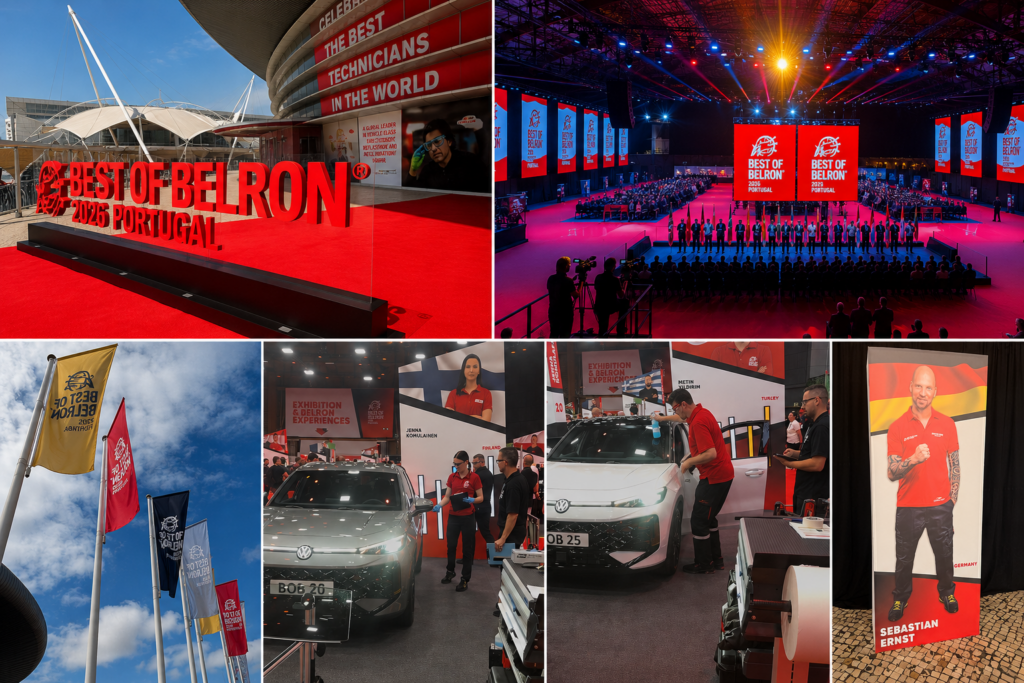
Belron’s commitment to technician development, calibration, and continuous improvement
That message resonated strongly at Best of Belron because Belron already operates at the intersection of safety, technology and customer trust. The company’s commitment to technician development, calibration capability and continuous improvement positions it well for a future in which restoring intelligent vehicle systems becomes as important as replacing damaged glass.
The future of the automotive industry will not be defined simply by who builds the best electric vehicle. It will be determined by who best integrates hardware, software, artificial intelligence, data and services into a seamless mobility experience. China has demonstrated that this future is arriving faster than many expected.
For the automotive aftermarket, the opportunity is equally significant. As vehicles become smart devices, companies that successfully evolve from repairing components to restoring intelligent systems will play an increasingly critical role in enabling safe, connected and trusted mobility.
That was the central message I was privileged to share with Belron’s global leadership in Lisbon. I believe it will become one of the defining challenges-and opportunities-for our industry over the coming decade.
About Bill Russo
Bill Russo is the Founder and CEO of Automobility Ltd , and is currently serving as the Chairman of the Automotive Committee at the American Chamber of Commerce in Shanghai. His over 40 years of experience includes 15 years as an automotive executive with Chrysler, including 22 years of experience in China and Asia. He has also worked nearly 12 years in the electronics and information technology industries with IBM and Harman. He has worked as an advisor and consultant for numerous multinational and local Chinese firms in the formulation and implementation of their global market and product strategies. Bill is a contributing author to the book Selling to China: Stories of Success, Failure, and Constant Change (2023), where he describes how China has become the most commercially innovative place to do business in the world’s auto industry – and why those hoping to compete globally must continue to be in the market.
Contact Bill by email at bill.russo@automobility.io
About Automobility
Automobility Limited is global Strategy & Investment Advisory firm based in Shanghai that is focused on helping its clients to Build and Profit from the Future of Mobility. We help our clients address and solve their toughest business and management issues that arise in midst of fast changing, complicated and ambiguous operating environment. We commit to helping our clients to not only “design” the solutions but also raise or deploy capital and assist in implementation, often together with our clients.
Contact us by email at info@automobility.io
Sorry, the comment form is closed at this time.