


26 Jun Mexico at the Crossroads: Reflections from a Week in Mexico City and Monterrey
June 6, 2026


Industry executives gathered in Mexico City to discuss how software, connectivity, and ecosystem integration are becoming the next sources of competitive advantage.
Industry executives gathered in Mexico City to discuss how software, connectivity, and ecosystem integration are becoming the next sources of competitive advantage.
While electrification remains a central topic throughout the industry, the discussion quickly moved beyond batteries and charging infrastructure.
Participants explored a broader question: what happens after electrification becomes mainstream?
According to Russo, the next phase of mobility will be defined by the convergence of software, connectivity, artificial intelligence, and intelligent mobility ecosystems.
“The future will not only be electric,” he argued during the discussions. “It will be intelligent.”
The distinction is significant. While many countries and companies continue to focus primarily on vehicle electrification, China’s automotive industry has increasingly shifted toward software-defined vehicles, connected ecosystems, autonomous driving capabilities, and integrated digital platforms.
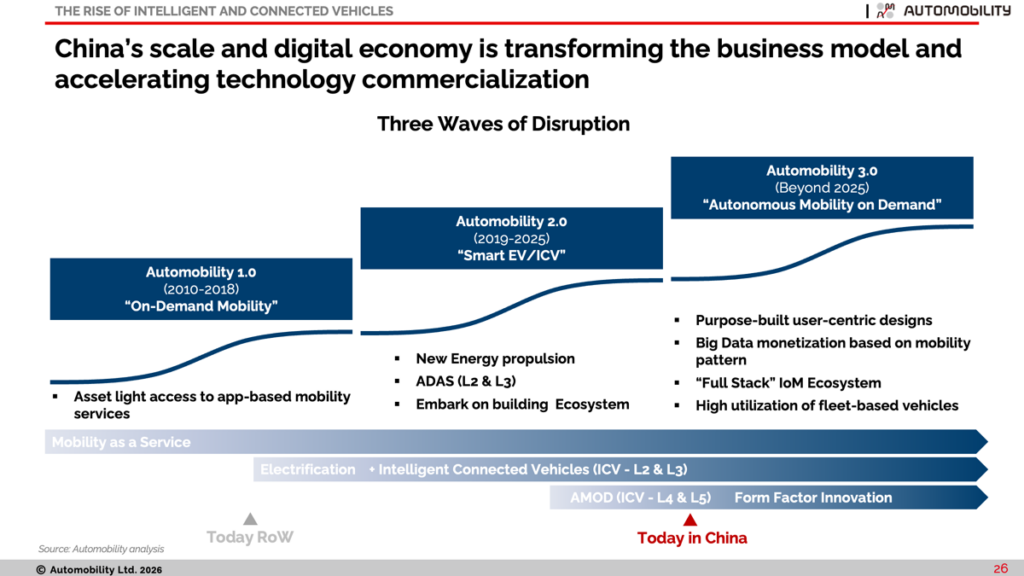
The evolution from Mobility-as-a-Service to Smart EVs and ultimately Autonomous Mobility on Demand illustrates how industry competition has moved beyond electrification.
That transition has allowed Chinese automakers to move from technology followers to what Russo describes as “innovation super scalers”—companies capable of rapidly industrializing new technologies and bringing them to market at unprecedented speed.
For Mexico, the implication is clear: maintaining competitiveness will require capabilities that extend beyond manufacturing excellence alone.
The Car Becomes a Device
The conversation intensified later in Monterrey, where Russo addressed executives and suppliers associated with the Cluster Automotriz de Nuevo León (CLAUT), one of Latin America’s most influential automotive industry organizations.
The reaction from attendees reflected both interest and concern.
One participant summarized the central argument in simple terms:
“The car became a device.”
The observation captured a fundamental shift underway across the industry.
For more than a century, automotive competition centered on mechanical engineering, manufacturing quality, and vehicle performance. Increasingly, however, value creation is shifting toward software architecture, user experience, connectivity, artificial intelligence, and ecosystem integration.
The implications are profound.
Smartphone manufacturers are entering the automotive sector. Technology companies are becoming vehicle platform providers. Software updates increasingly improve vehicles after they are sold. Data has become a strategic asset.
In this new environment, traditional automotive capabilities remain necessary but are no longer sufficient.
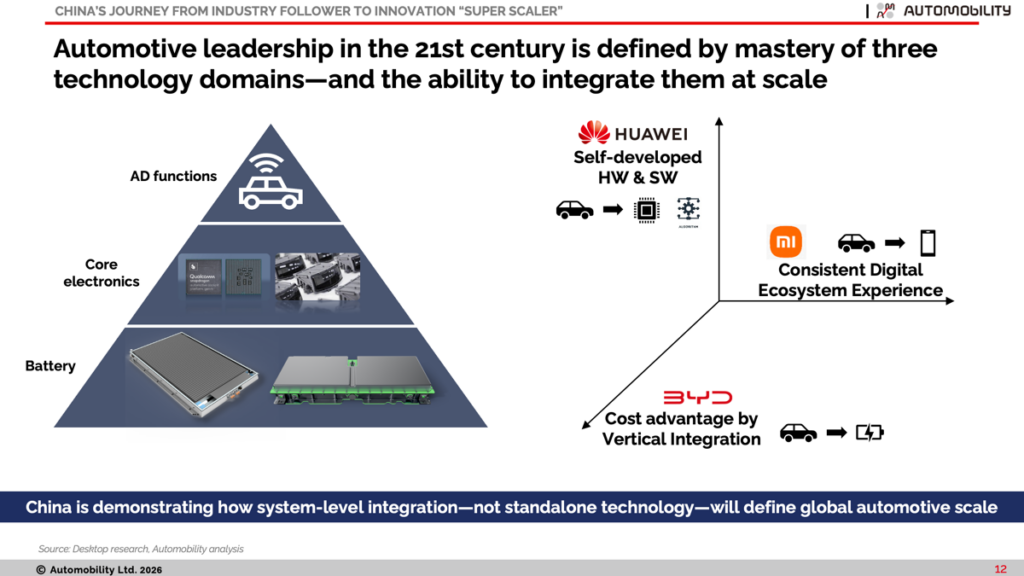
Automotive leadership increasingly depends on the integration of batteries, electronics, software, and autonomous driving technologies.
As Russo explained during multiple presentations, China’s rise cannot be understood solely through the lens of low-cost manufacturing or industrial policy. Rather, it reflects a deliberate transition from machine-centric thinking toward digital-centric thinking.
That shift is reshaping the competitive landscape globally.
A Warning from China
The message resonated strongly enough to attract local media attention.
A leading Monterrey business publication summarized the presentation under a headline warning that traditional automakers risk losing market position if they fail to adapt to the new competitive realities emerging from China.
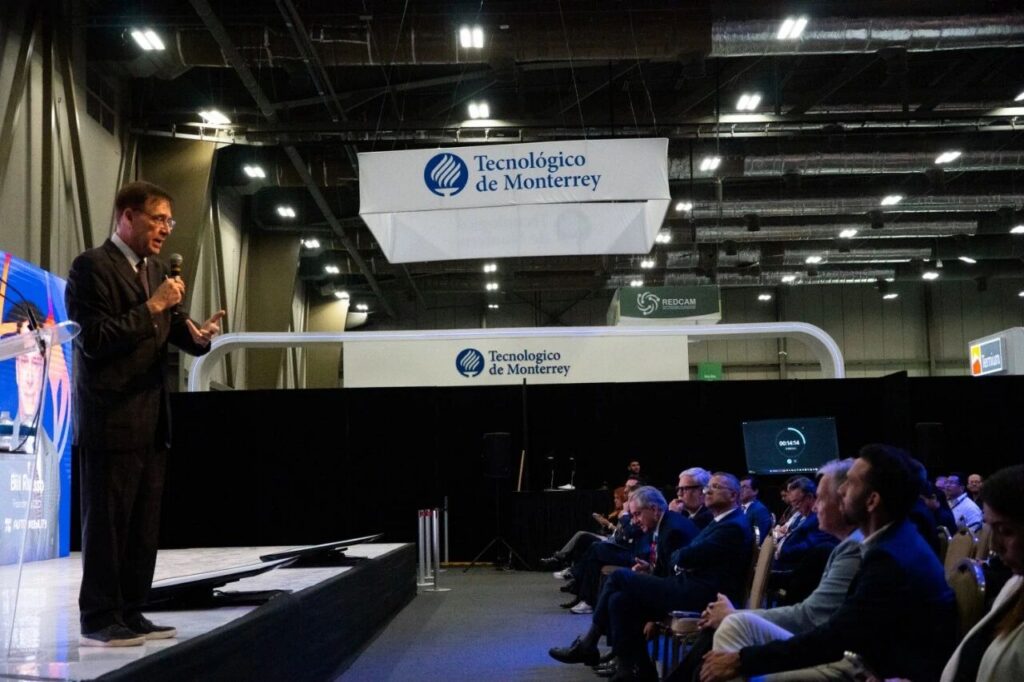
During presentations in Monterrey, Russo argued that China’s competitive advantage stems from industrialized innovation and digital operating models rather than labor-cost advantages.
The argument was not that Chinese companies are winning because of lower labor costs.
Instead, they are succeeding because they embraced a different operating model.
China’s automotive ecosystem compressed development cycles, integrated research and manufacturing more closely, accelerated software deployment, and built industrial systems capable of learning and improving at unprecedented speed.
The result is what many industry observers now refer to as “China Speed.”
Vehicle development programs that once required four to five years can now be completed in significantly less time. Software improvements can be delivered over the air. Manufacturing systems increasingly operate as digital platforms rather than traditional production facilities.
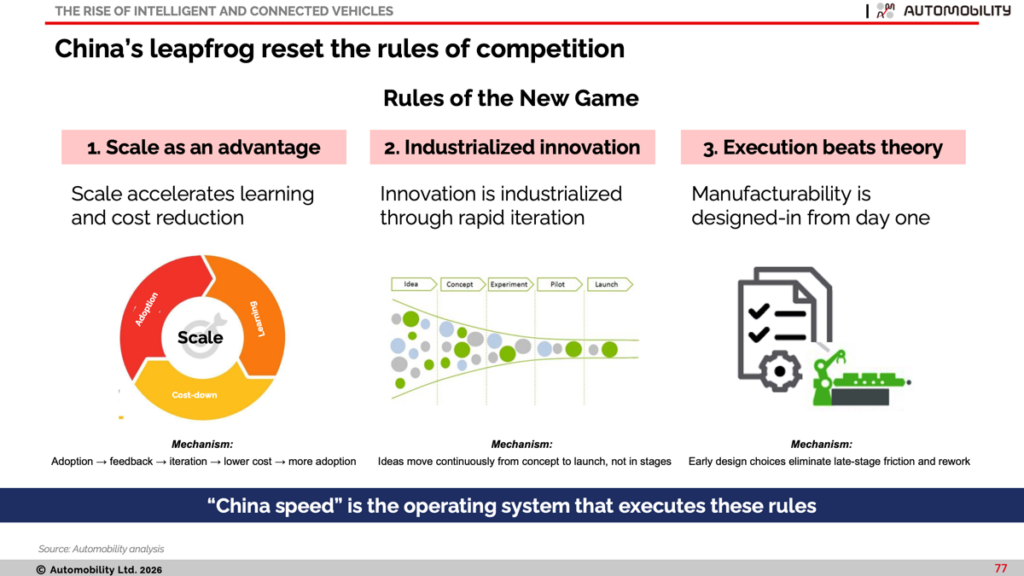
China’s automotive ecosystem has combined scale, rapid iteration, and manufacturing integration into a new competitive model.
The competitive framework itself has changed. Scale accelerates learning. Innovation is industrialized through continuous iteration. Manufacturability is designed into products from the beginning rather than added later.
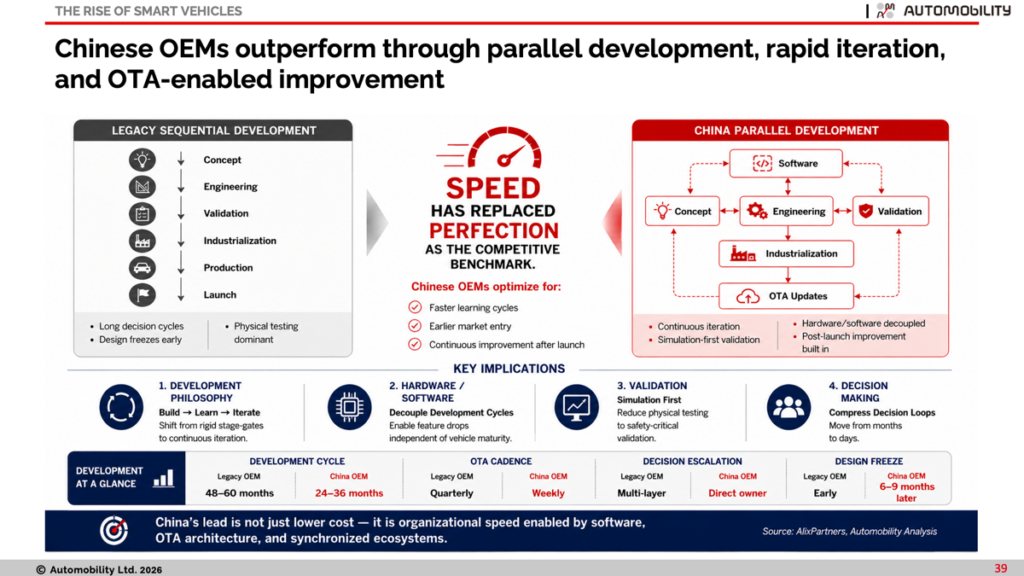
Chinese automakers increasingly use parallel development and over-the-air updates
to compress product development timelines.
“The battle is moving toward software, ecosystem integration, AI, and intelligent mobility platforms,” Russo told attendees at the Global Transportation & Innovation Summit.
The Emergence of Tier 0.5
A recurring topic throughout the week involved the evolution of the automotive supply chain itself.
Traditional industry structures have long been organized around automakers, Tier 1 suppliers, and lower-tier component manufacturers.
However, smart vehicles are creating demand for a new type of participant—an orchestrator capable of integrating hardware, software, electronics, artificial intelligence, and digital services across multiple domains.
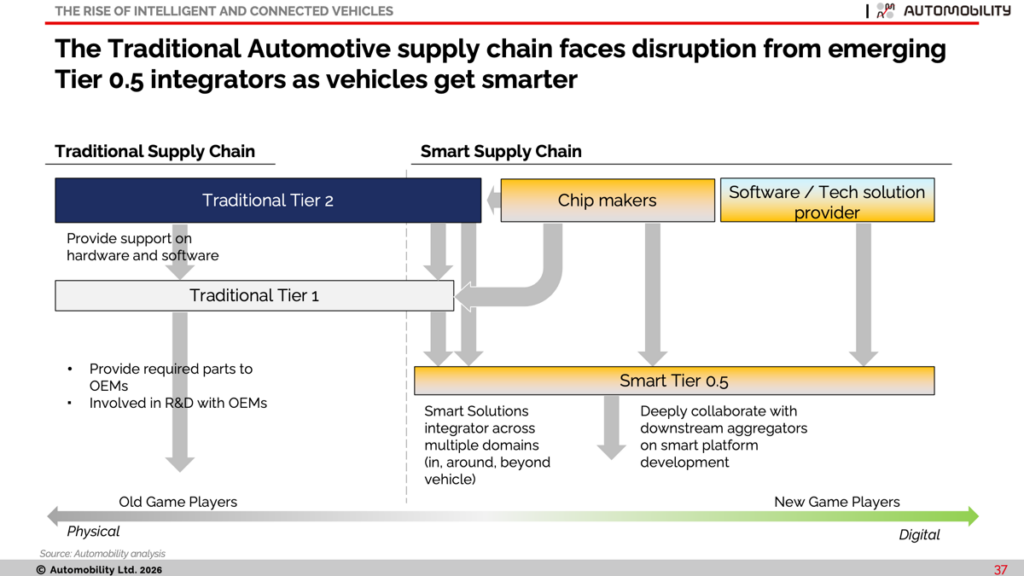
The rise of smart vehicles is creating a new class of “Tier 0.5” integrators that coordinate
software, electronics, chips, and intelligent systems.
Russo described these emerging players as “Tier 0.5” organizations.
Rather than supplying individual components, they coordinate entire intelligent vehicle platforms.
Examples are already emerging in China, where companies such as Huawei have become increasingly influential in shaping vehicle architecture, user experience, software systems, and ecosystem integration across multiple automotive brands.
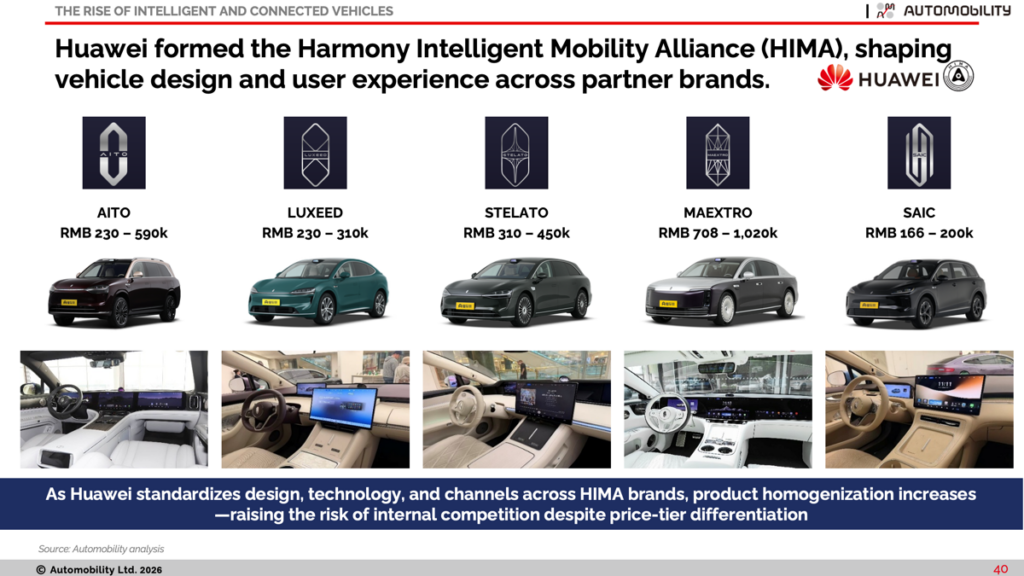
Huawei’s Harmony Intelligent Mobility Alliance demonstrates how ecosystem orchestrators
are reshaping vehicle development and user experience.
For suppliers gathered in Nuevo León, the concept generated significant discussion.
Many recognized that future competitiveness may depend not only on manufacturing components but also on participating in broader intelligent mobility ecosystems.
The concept carries particular relevance for North America, where no equivalent cross-OEM orchestrator currently exists. As software becomes increasingly central to vehicle value creation, the opportunity for new ecosystem leaders continues to expand.
Mexico’s Strategic Opportunity
Despite concerns about growing Chinese competition, the discussions throughout the week were notably optimistic about Mexico’s future.
The consensus view was that Mexico possesses unique strategic advantages that few countries can replicate.
The country combines a world-class manufacturing base, deep supplier networks, proximity to North American markets, and the benefits of USMCA integration.
At the same time, geopolitical realities are creating opportunities for localization and regionalization of supply chains.
The challenge, however, is ensuring that Mexico moves beyond assembly and into higher-value activities.
Future competitiveness will increasingly depend on engineering capabilities, software development, electronics expertise, systems integration, and advanced manufacturing.
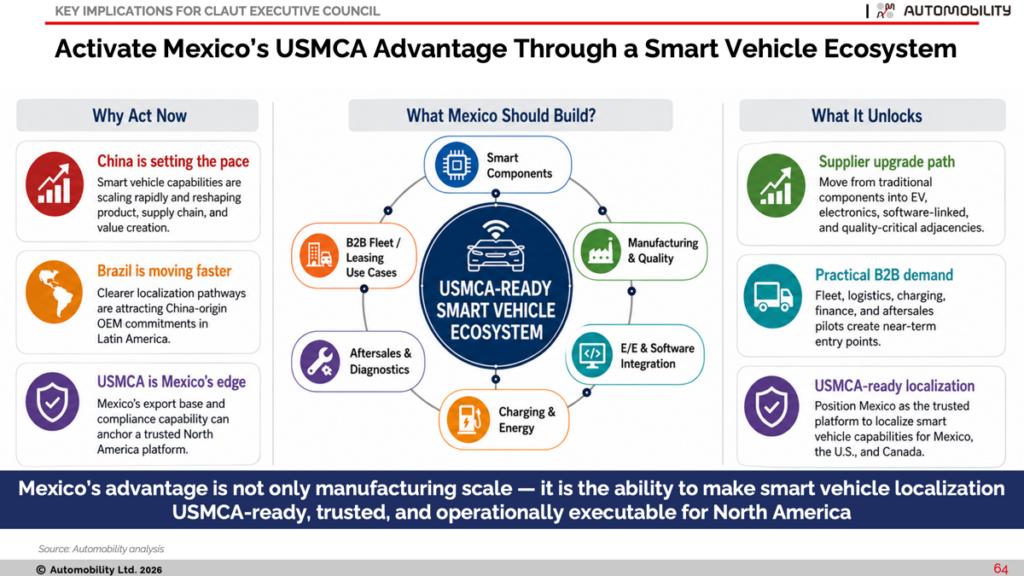
Mexico is increasingly viewed as a strategic localization platform for smart vehicle technologies entering North America.
Rather than positioning itself as a simple destination for low-cost production, Mexico has an opportunity to become a trusted, USMCA-compliant localization platform for intelligent vehicle ecosystems.
That distinction became a recurring theme throughout the week.
In presentations comparing Mexico and Brazil, Russo argued that Mexico’s strategic advantage lies not in unrestricted China-origin assembly but in compliant regional integration that aligns with North American requirements while enabling smart vehicle localization.
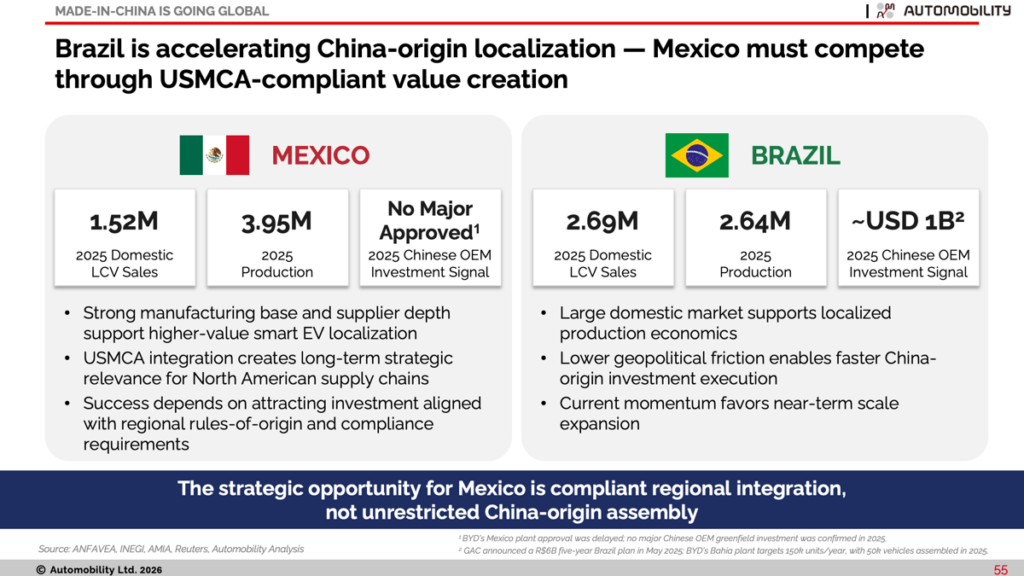
The strategic opportunity for Mexico lies in compliant regional integration rather than unrestricted China-origin assembly.
The opportunity is therefore not merely to build vehicles.
It is to help build the next generation of intelligent mobility platforms.
Looking Ahead
The discussions in Mexico City and Monterrey reflected a broader reality facing the global automotive industry.
The transition to electric vehicles is no longer the primary story.
Electrification is increasingly becoming the foundation upon which a larger transformation is taking place.
The next competitive battleground will be intelligence.
Software-defined vehicles, connected ecosystems, artificial intelligence, autonomous technologies, and integrated mobility platforms are rapidly becoming the new determinants of success.
China currently occupies the leading edge of that transformation, but the implications extend far beyond China itself.
For Mexico, the question is not whether this shift will occur.
The question is how quickly its automotive ecosystem can adapt.
The country’s manufacturing strength, supplier depth, and strategic location provide a powerful foundation. Yet future leadership will require new capabilities, new partnerships, and a willingness to embrace a different model of competition.
As the conversations throughout the week repeatedly demonstrated, the future of mobility will belong not simply to those who build vehicles most efficiently, but to those who build ecosystems most effectively.
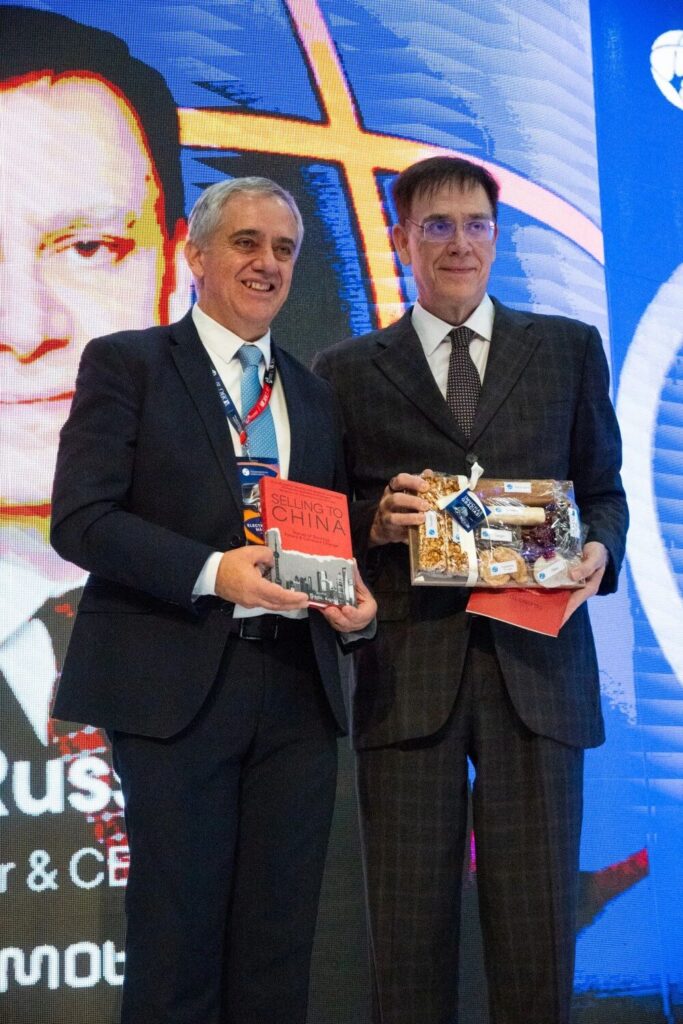
The visit concluded with discussions emphasizing collaboration between Mexican industry leaders and global mobility stakeholders as the sector enters a new phase of transformation.
Mexico now stands at an important crossroads.
The decisions made over the next several years may determine whether it remains a manufacturing powerhouse—or becomes a central architect of North America’s intelligent mobility future.
About Bill Russo
Bill Russo is the Founder and CEO of Automobility Ltd , and is currently serving as the Chairman of the Automotive Committee at the American Chamber of Commerce in Shanghai. His over 40 years of experience includes 15 years as an automotive executive with Chrysler, including 21 years of experience in China and Asia. He has also worked nearly 12 years in the electronics and information technology industries with IBM and Harman. He has worked as an advisor and consultant for numerous multinational and local Chinese firms in the formulation and implementation of their global market and product strategies. Bill is a contributing author to the book Selling to China: Stories of Success, Failure, and Constant Change (2023), where he describes how China has become the most commercially innovative place to do business in the world’s auto industry – and why those hoping to compete globally must continue to be in the market.
Contact Bill by email at bill.russo@automobility.ioinfo@automobility.io
About Automobility
Automobility Limited is global Strategy & Investment Advisory firm based in Shanghai that is focused on helping its clients to Build and Profit from the Future of Mobility. We help our clients address and solve their toughest business and management issues that arise in midst of fast changing, complicated and ambiguous operating environment. We commit to helping our clients to not only “design” the solutions but also raise or deploy capital and assist in implementation, often together with our clients.
Contact us by email at info@automobility.io
Sorry, the comment form is closed at this time.