


26 Apr Auto China 2026: From Smart EVs to Intelligent Mobility
By Bill Russo, Jackie Tang and Emily Wang
Auto China 2026 returns to Beijing this year, as the show continues its rotation between Beijing and Shanghai, running from April 24 to May 3, 2026.
Auto China 2026 will not feel like a traditional auto show. It will feel like a technology exhibition where the automobile is simply the delivery device.
For much of the past decade, the industry has been defined by electrification. In China, that phase is largely complete. What will be on display in Beijing is something more advanced—and more consequential: the transition from electric vehicles to intelligent mobility systems, where software, AI, and ecosystem integration determine competitive advantage.
This is not a single leap. It is the result of overlapping waves of transformation. The first wave brought mobility on demand. The second—now reaching maturity—scaled connected, electric vehicles. What we are beginning to see at Auto China 2026 is the early emergence of a third wave, where intelligence and autonomy start to reshape not just the product, but the business model itself.
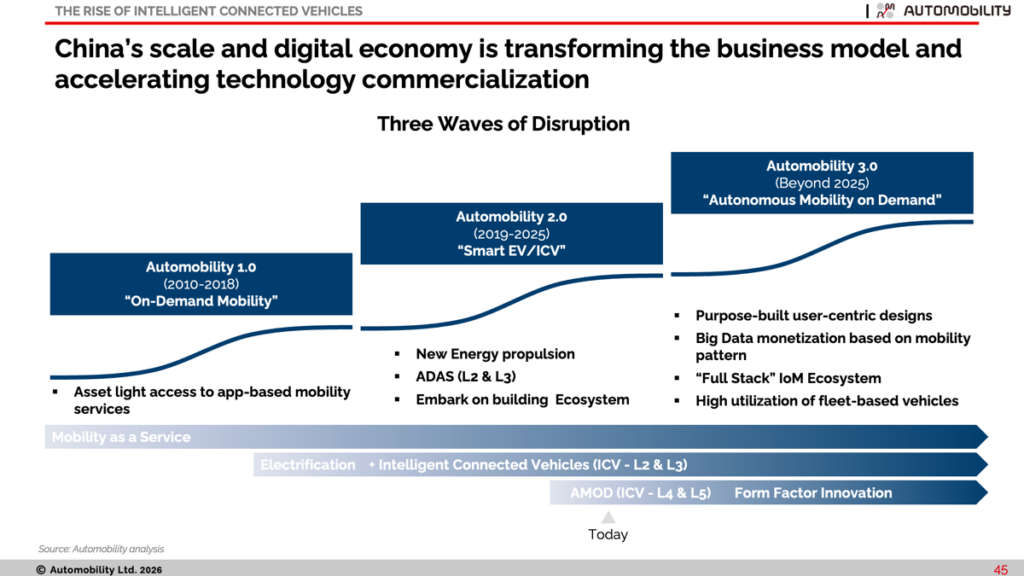
The show will not present this framework explicitly. But it will be visible in the products, the partnerships, and the strategies of the companies that matter.
Electrification Becomes Infrastructure
Electrification will dominate the show floor—but not in the way it once did.
The emphasis is no longer on whether vehicles are electric, but on how well the electric architecture performs. The shift toward 800V and higher-voltage platforms is now unmistakable, and importantly, it is no longer limited to niche or flagship models.
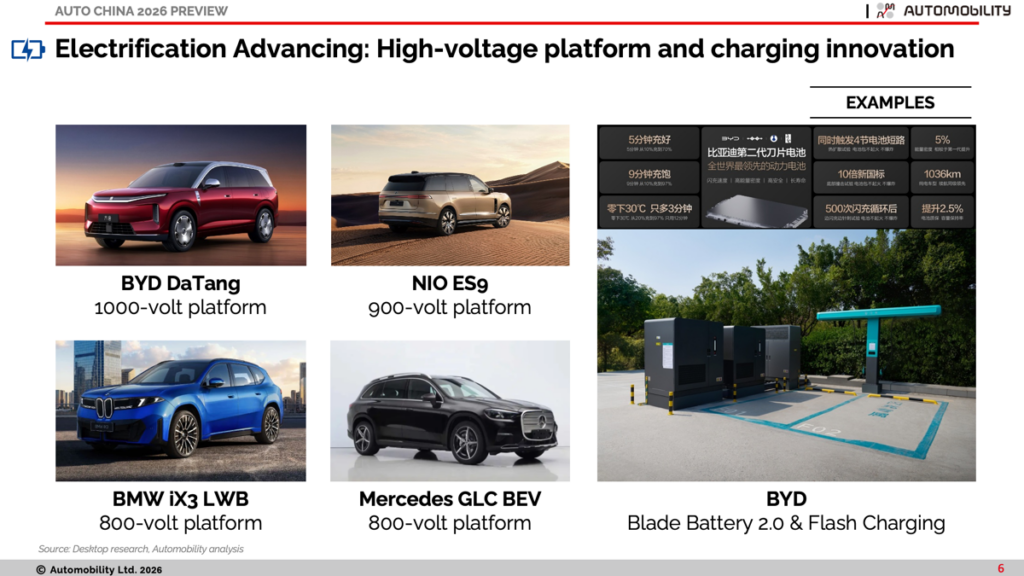
You will see this reflected across a range of vehicles:
-
BYD’s DaTang, pushing toward a 1000V architecture, reinforces the company’s ability to integrate battery and vehicle design at scale -
NIO’s ES9, built on a 900V platform, signals how premium players are aligning performance with ecosystem integration -
BMW’s iX3 LWB and Mercedes’ GLC BEV, both on 800V platforms, show how global OEMs are converging technically—but still playing catch-up on execution
At the same time, infrastructure solutions are diverging rather than consolidating. BYD’s Blade Battery 2.0 and flash charging push toward ultra-fast charging parity, while NIO continues to double down on battery swapping as a differentiated ownership model.
What this tells you is simple: electrification is no longer the innovation. It is the baseline capability, and the competition has shifted to how efficiently and seamlessly it is delivered.
Intelligence Moves Into the Mass Market
If electrification is the foundation, intelligence is now the battleground—and it is moving faster than most expected.
At Auto China 2026, the most important development will be the rapid scaling of L2+ and early L3 capabilities into mid-market vehicles. What was recently a premium differentiator is quickly becoming standard.
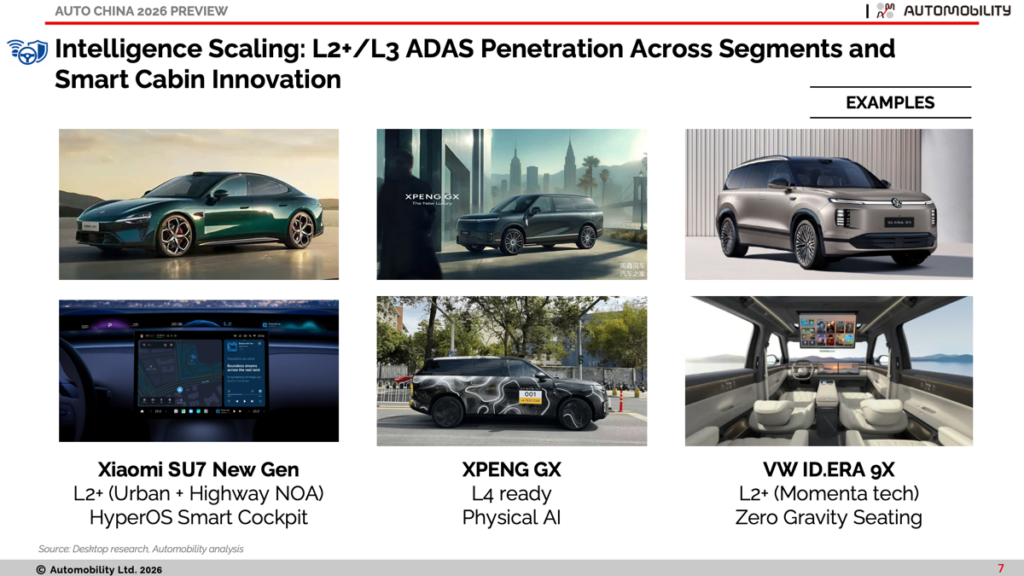
The clearest signals come from a new generation of products:
-
Xiaomi SU7 (new generation) integrates L2+ urban and highway NOA with its HyperOS ecosystem—turning the car into an extension of the user’s digital life -
XPENG GX, positioned as “L4-ready,” emphasizes not just ADAS capability but a broader concept of “physical AI” embedded in the vehicle -
VW ID.ERA 9X, leveraging Momenta technology, reflects how global OEMs are now dependent on local partners for competitive ADAS capability
At the same time, the cockpit is undergoing a parallel transformation. The vehicle interior is no longer defined by materials or layout, but by interface, intelligence, and personalization. Xiaomi’s OS integration and XPENG’s software-first architecture point to a future where the car behaves more like a smart device than a traditional machine.
This is where the second wave—Smart EV/ICV—begins to transition into the third. The hardware is largely in place. Now the differentiation comes from how intelligently it is used.
Chinese Brands Redefine Premium
Perhaps the most striking shift at Auto China 2026 will be the confidence with which Chinese brands are moving into higher-end segments.
This is not incremental. It is structural.
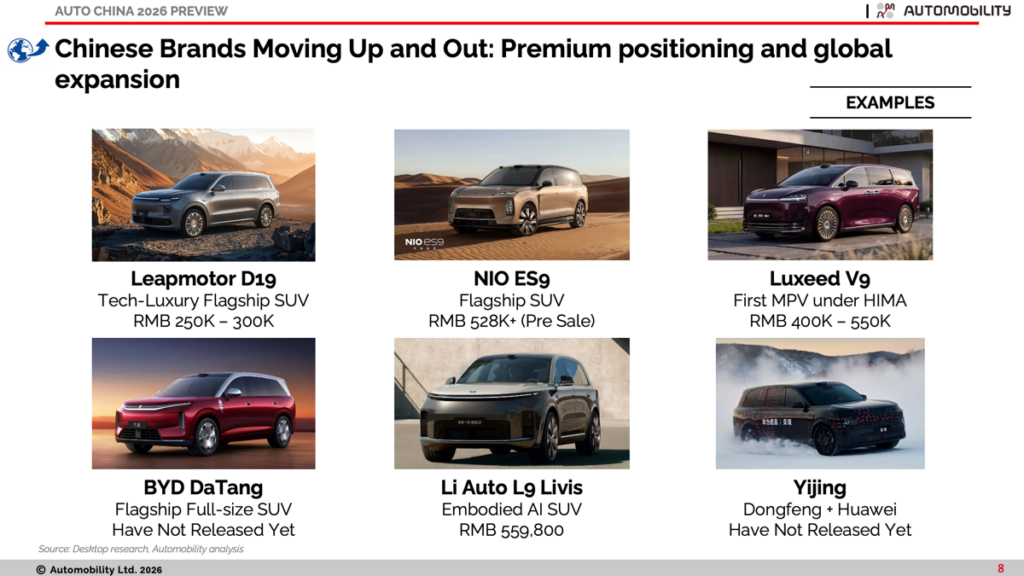
Vehicles like:
-
Leapmotor D19, targeting the RMB 250–300K range with a tech-forward positioning -
NIO ES9, reinforcing its presence above RMB 500K -
Luxeed V9 (built by Chery under Huawei’s HIMA ecosystem), pushing into the RMB 400–550K MPV segment -
Li Auto L9 LiviS, blending large-format SUV practicality with embodied AI positioning -
BYD DaTang, extending BYD’s reach into full-size flagship territory
…collectively signal that Chinese OEMs are no longer competing from below. They are redefining the premium segment from within.
What differentiates these vehicles is not brand heritage. It is technology density, interior experience, and value proposition. Large screens, intelligent driving, spacious cabin design, and ecosystem integration are replacing traditional markers of luxury.
At the same time, this push upmarket is tightly linked to global expansion. Companies like Chery and SAIC are leveraging strong export momentum, while others are positioning premium products as a gateway into Europe and beyond.
The shift is clear: Chinese brands are not just gaining share—they are reshaping the competitive definition of premium.
Global OEMs Adapt Through Localization
For global OEMs, the story at Auto China 2026 is adaptation under pressure.
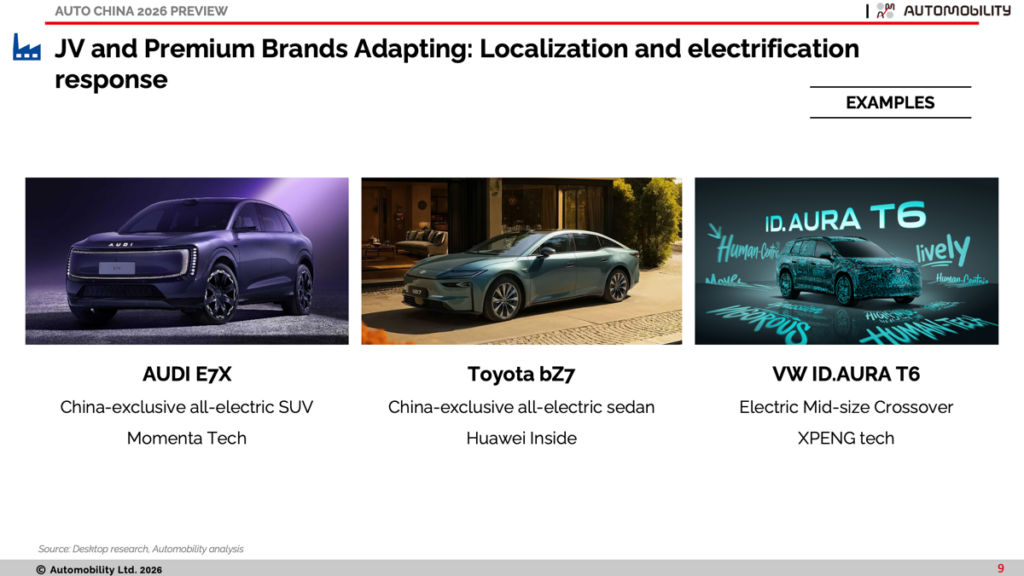
The most visible evidence is the rise of China-specific EV programs, often built with deep local partnerships:
-
Audi E7X, integrating Momenta technology, reflects a shift toward localized ADAS stacks -
Toyota bZ7, developed with Huawei inside, signals a willingness to adopt external software ecosystems -
VW ID.AURA T6, leveraging XPENG technology, represents one of the clearest examples of partnership-driven transformation
These are not isolated cases. They are indicators of a broader structural shift.
Global OEMs are moving from a model of control to one of collaboration. They are trading ownership of key technology layers for speed, relevance, and market access.
This is a difficult transition. It challenges long-standing assumptions about brand, capability, and differentiation. But in China’s market environment—defined by speed, scale, and relentless competition—it is becoming unavoidable.
The Ecosystem Players Take Center Stage
Running through all of these themes is the growing influence of ecosystem players.
Huawei is the most prominent example. Through its HIMA model and technology stack, it is shaping vehicle intelligence across multiple OEMs without being a traditional automaker. Its presence will be felt across brands, segments, and price points.
Xiaomi, meanwhile, represents a different form of disruption: the integration of automotive into a broader consumer electronics ecosystem. Its approach reframes the vehicle as part of a connected lifestyle, not a standalone product.
These companies are not just participants. They are redefining where value sits in the industry.
What to Watch at Auto China 2026
Stepping back from individual launches, a few patterns emerge:
-
The normalization of high-voltage platforms across segments -
The spread of L2+ capability into mass-market vehicles -
The confidence of Chinese brands in premium pricing -
The increasing visibility of partnerships in global OEM strategies
Each of these signals points to the same conclusion: the industry is reorganizing itself around intelligence and ecosystems.
The Beginning of the Third Wave
Auto China 2026 does not mark the arrival of full autonomy. But it does mark the point where the industry begins to move decisively beyond Smart EVs toward intelligent, connected, and eventually autonomous mobility systems.
The first wave changed how mobility is accessed.
The second changed how vehicles are powered and connected.
The third—now emerging—will change how mobility is experienced, monetized, and integrated into daily life.
China is not just participating in this transition. It is compressing it.
About the Authors
Bill Russo is the Founder and CEO of Automobility Limited, and is currently serving as the Chairman of the Automotive Committee at the American Chamber of Commerce in Shanghai. His over 40 years of experience includes 15 years as an automotive executive with Chrysler, including 22 years of experience in China and Asia. He has also worked nearly 12 years in the electronics and information technology industries with IBM and Harman. He has worked as an advisor and consultant for numerous multinational and local Chinese firms in the formulation and implementation of their global market and product strategies. Bill is a contributing author to the book Selling to China: Stories of Success, Failure, and Constant Change (2023), where he describes how China has become the most commercially innovative place to do business in the world’s auto industry – and why those hoping to compete globally must continue to be in the market.
Contact Bill by email at bill.russo@automobility.io
Jackie Tang is a Senior Associate at Automobility Limited.She has over a decade of professional experience, including 9 years in consulting, specializing in the automotive and digital sectors, and 6 years in the mobility and autonomous driving industry. She possesses a deep understanding of China’s automotive industry, particularly in the areas of shared, electrified, connected, and autonomous transformations. Jackie has also led several pioneering “0-1” projects, from the design of innovative business models to their successful implementation.
Contact Jackie by email at jackie.tang@automobility.io
Emily Wang is a Senior Associate of Automobility Limited. She has 12 years of experience in Management Consulting and Marketing in Greater China and U.S., spanning over multiple consumer and industrial sectors. She is knowledgeable about China’s mobility market, technology innovations and digital ecosystem. She has helped multinational, Chinese POE and SOE and startup clients developing strategy for new market entry, M&A pipeline, due diligence, organization structure and operating model design etc.
Contact Emily by email at emily.wang@automobility.io
About Automobility
Automobility Limited is global Strategy & Investment Advisory firm based in Shanghai that is focused on helping its clients to Build and Profit from the Future of Mobility. We help our clients address and solve their toughest business and management issues that arise in midst of fast changing, complicated and ambiguous operating environment. We commit to helping our clients to not only “design” the solutions but also raise or deploy capital and assist in implementation, often together with our clients.
Contact us by email at info@automobility.io
Sorry, the comment form is closed at this time.